2026 Engineering Update: Yes, 3840Hz refresh rate is enough for most LED video walls used for corporate meetings, retail, hotels, control rooms, and standard video playback. However, 3840Hz alone does not guarantee camera-safe performance. For broadcast, XR, virtual production, slow-motion filming, or other camera-critical applications, PWM frequency, grayscale performance, scan mode, driver ICs, and camera settings must also be evaluated.
Why 3840Hz Is Still a Misunderstood LED Display Specification in 2026
When buyers ask “is 3840Hz refresh rate enough for LED video walls?”, they are usually facing a real project problem—camera flicker, banding, or unstable images—despite using screens advertised as high refresh rate.
In 2026, 3840Hz is widely used as a standard high-refresh specification for commercial LED displays. Yet screens with the same advertised 3840Hz refresh rate can still perform very differently, particularly when viewed through a camera.
So the real question is not whether 3840Hz is high, but: Is 3840Hz refresh rate enough for your application?
This article answers that question from an engineer’s perspective, breaking down:
- What 3840Hz actually means
- When 3840Hz LED video wall performance is sufficient
- Why LED screen flicker at 3840Hz still happens
- The recommended refresh rate for LED video wall projects by use case
What Does 3840Hz Refresh Rate Really Mean?
Refresh rate (Hz) refers to how many times per second the LED screen updates its image.
- 3840Hz = 3,840 image refresh cycles per second
- It reduces visible flicker to the human eye
- It improves motion smoothness and brightness stability
However, refresh rate alone does NOT guarantee camera friendliness or professional image quality.
Engineers treat refresh rate as one variable in a larger signal-to-light system.
Refresh rate is an important specification, but it should never be evaluated in isolation.
Professional buyers typically assess refresh rate together with pixel pitch, brightness, display technology, power consumption, lifespan, and supplier capabilities to determine the most suitable solution for a project.
If you’re comparing LED display options, our LED Video Wall Buying Guide provides a complete framework for evaluating all key purchasing factors before making a final decision.
Many buyers assume a higher refresh rate automatically guarantees better performance. In reality, issues such as thermal design, power stability, and component quality can create cheap LED wall problems that affect long-term display reliability just as much as refresh rate itself.
Is 3840Hz Refresh Rate Enough for Human Viewing?
Short Answer: Yes, for most indoor applications
For human vision, 3840Hz is generally more than enough.
Typical use cases where 3840Hz LED video wall performance is sufficient:
| Application | Verdict |
|---|---|
| Corporate meeting rooms | ✅ Enough |
| Indoor retail signage | ✅ Enough |
| Hotel lobbies | ✅ Enough |
| Control rooms (non-broadcast) | ✅ Usually enough |
At normal viewing distances, the human eye cannot detect flicker beyond a few hundred Hz. From a visual comfort standpoint, 3840Hz already exceeds requirements. (by. Zora)
Why LED Screen Flicker at 3840Hz Still Happens on Camera
This is where confusion begins.
Many projects experience LED screen flicker at 3840Hz, especially during:
- Live streaming
- Broadcast filming
- Hybrid meeting recording
- XR / virtual production
The core reason:
Camera sensors do not “see” like human eyes
They interact with:
- PWM dimming frequency
- Scan method (row/column driving)
- Gray scale bit depth
- Driver IC response speed
- Camera shutter speed & frame rate
3840Hz refresh rate alone does not solve camera flicker.
Engineer Breakdown: Why 3840Hz May NOT Be Enough
1. PWM Frequency Is Too Low
Many LED panels advertise 3840Hz refresh rate, but their PWM dimming frequency may be only 1–2kHz.
Result:
- Banding on camera
- Brightness pulsing at low gray levels
Engineers care more about PWM frequency consistency than marketing refresh numbers.
2. Gray Scale Is Limited (14-bit vs 16-bit)
Low gray-level instability causes:
- Flashing in dark scenes
- Color breakup on camera
Even at 3840Hz:
- 14-bit gray scale = higher risk
- 16-bit or higher = stable broadcast image
3. Scan Mode Bottlenecks (1/16, 1/32 Scan)
High scan ratios reduce effective refresh per pixel.
Example:
- 3840Hz + 1/32 scan ≠ true 3840Hz per pixel
This mismatch is a common cause of camera flicker despite high refresh specs.
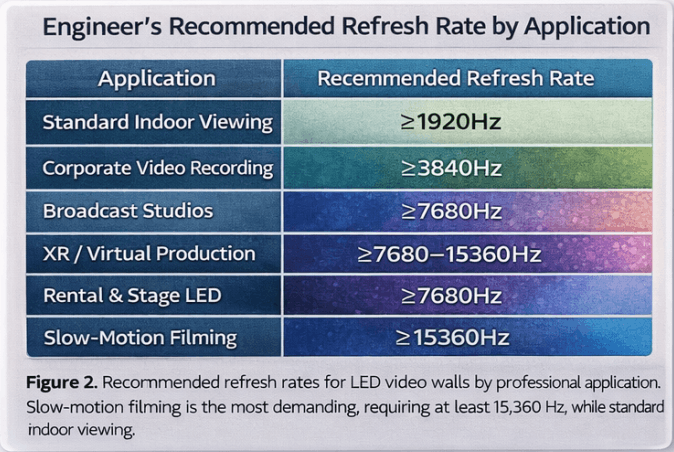
Recommended Refresh Rate for LED Video Wall by Application
So what is the recommended refresh rate for LED video wall projects in 2026?
Engineer-Level Recommendation Table
| Application | Recommended Refresh Rate |
|---|---|
| Standard indoor viewing | ≥1920Hz |
| Corporate video recording | ≥3840Hz |
| Broadcast studios | ≥7680Hz |
| XR / virtual production | ≥7680–15360Hz |
| Rental & stage LED | ≥7680Hz |
| Slow-motion filming | ≥15360Hz |
3840Hz is a baseline, not a universal solution.
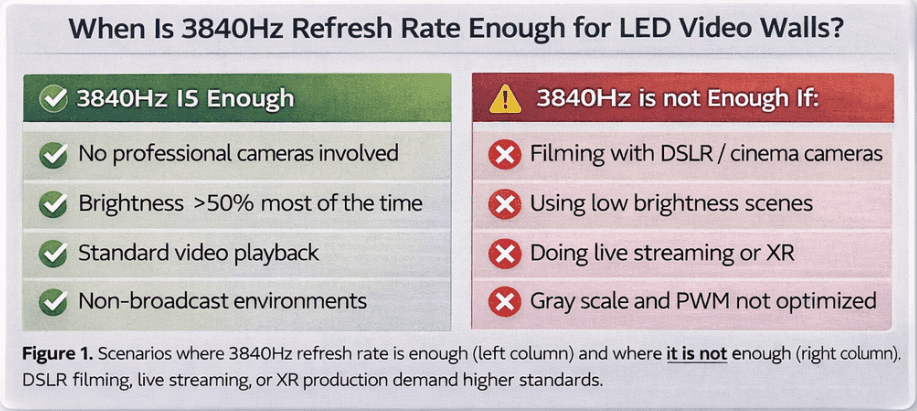
When Is 3840Hz Refresh Rate Enough?
✅ 3840Hz Is Enough If:
- No professional cameras involved
- Brightness >50% most of the time
- Standard video playback
- Non-broadcast environments
❌ 3840Hz Is NOT Enough If:
- Filming with DSLR / cinema cameras
- Using low brightness scenes
- Doing live streaming or XR
- Gray scale and PWM are not optimized
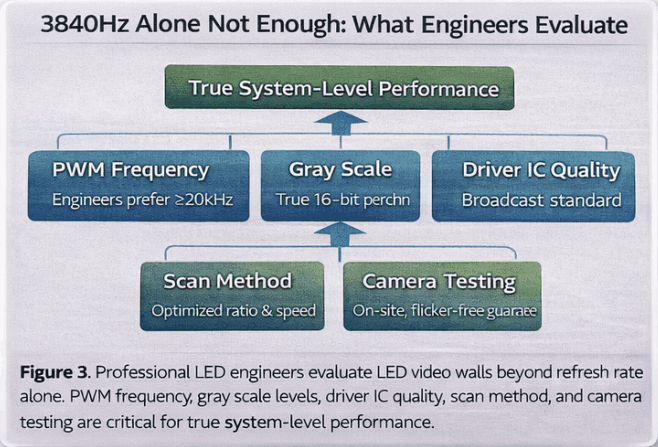
What Engineers Look at Beyond Refresh Rate
Professional LED engineers evaluate system-level performance, including:
- Driver IC architecture
- PWM frequency (≥20kHz preferred)
- True 16-bit gray scale
- Scan ratio optimization
- Calibration at low brightness
- Camera shutter compatibility
These factors also play an important role in long-term system stability and can directly influence LED video wall lifespan, especially in applications that operate for extended hours every day.
This is why two screens with “3840Hz” can perform completely differently on camera.
The same principle applies to pricing. Two LED video walls may share identical refresh rate specifications while having significant differences in reliability, lifespan, and long-term operating costs.(LED video wall price 2026)
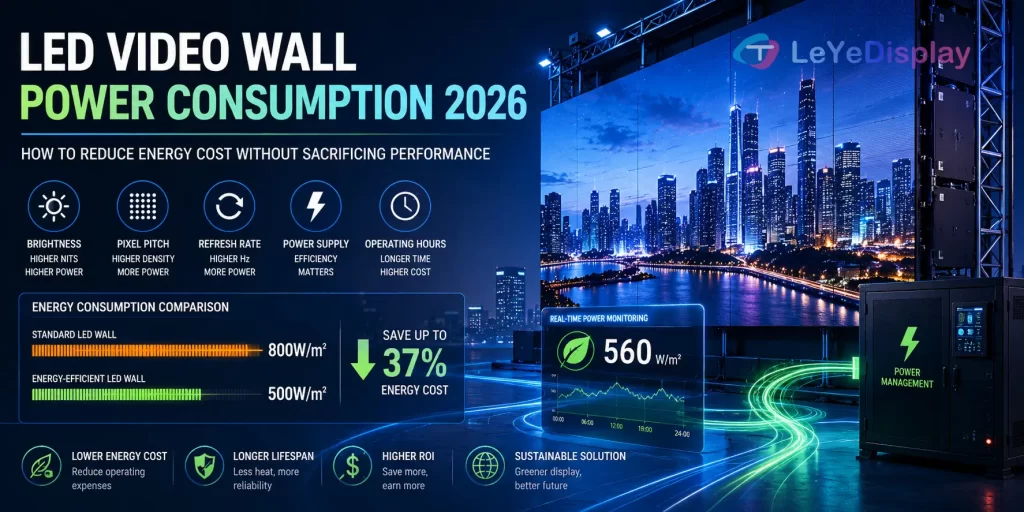
In large commercial projects, engineering decisions affect more than image quality. They also influence energy efficiency, maintenance requirements, and long-term ownership costs throughout the lifecycle of the display.(LED video wall power consumption)
Is 3840Hz Refresh Rate Enough?
Yes — but only in the right context.
3840Hz refresh rate is enough for human viewing and basic professional use. However, buyers should avoid evaluating LED displays based on refresh rate alone. Factors such as system reliability, power efficiency, maintenance requirements, and total ownership cost often have a greater impact on long-term project success.
It is NOT enough by itself for camera-critical applications.
If your project involves filming, broadcasting, or future-proof content creation, refresh rate must be evaluated together with driver IC, PWM, gray scale, and scan method.
Engineer’s Advice Before You Buy
Before choosing an LED video wall, always ask:
- Is 3840Hz refresh rate enough for my cameras?
- What is the PWM dimming frequency?
- Is gray scale true 16-bit?
- Has the screen been camera-tested?
If a supplier cannot answer these questions clearly, the spec sheet alone is not trustworthy.
3840Hz PWM vs. High-End Driver ICs in 2026
For modern B2B procurements, achieving a 3840hz pwm refresh rate depends heavily on the driving architecture. Standard displays use basic double-latch driver ICs to hit 3840Hz, which might suffer from grayscale loss at low brightness levels. Premium solutions, such as the [LeYeDisplay TQW Series], utilize advanced PWM driver ICs that stabilize grayscale performance even under dimmed ambient lighting.
Below is a quick technical reference for 2026 project specifications:
| Refresh Rate Metric | Driver IC Type | Best Applied Environment | Camera/Phone Scanline Risk |
| <1920Hz | Traditional Constant Current | Static retail signage (Non-video) | High Risk (Severe banding) |
| 3840Hz PWM | High-Gray Double-Latch | Commercial billboards, shopping malls | Safe for standard mobile shooting |
| 7680Hz+ | Flagship High-Refresh PWM | Broadcast studios, XR stages, Virtual production | Zero Risk (Pro-camera ready) |
Need a camera-safe LED video wall recommendation?
If your project involves broadcast, live streaming, XR, virtual production, or professional filming, refresh rate should be evaluated together with the complete LED driving system and camera setup. Contact our team if you need an application-specific recommendation or camera test guidance.
📩 Contact us for an application-specific evaluation and camera test guidance.