Energy efficiency is becoming one of the most important topics in the global LED display industry.
As electricity costs continue rising across commercial, retail, sports, and rental applications, buyers are paying far more attention to long-term operating expenses rather than only initial hardware pricing.
In 2026, the discussion around LED video wall power consumption 2026 is no longer limited to technical engineers. It now directly affects:
- Project budgeting
- Operating profitability
- Sustainability targets
- System design decisions
- Long-term maintenance planning
For many LED display projects, electricity cost over several years can become a significant part of total ownership cost.
This guide explains what affects LED video wall power usage, how buyers can reduce unnecessary energy consumption, and which technical decisions matter most in real-world projects.
Power consumption is only one part of the total purchasing decision. For a broader project-planning framework, our LED Video Wall Buying Guide explains how to evaluate pixel pitch, display technology, price, refresh rate, lifespan, installation requirements, and supplier selection together.
Why LED Video Wall Power Consumption Matters More in 2026
Several major industry trends are driving increased focus on energy efficiency.
The LED video wall power consumption 2026 discussion is becoming more important because of:
- Rising global electricity prices
- Longer daily operating hours
- Larger LED installations
- Sustainability regulations
- Increased outdoor digital advertising
- High-brightness commercial applications
According to recent professional AV industry reports, energy efficiency is becoming a critical purchasing factor for commercial display systems.
What Determines LED Video Wall Power Consumption?
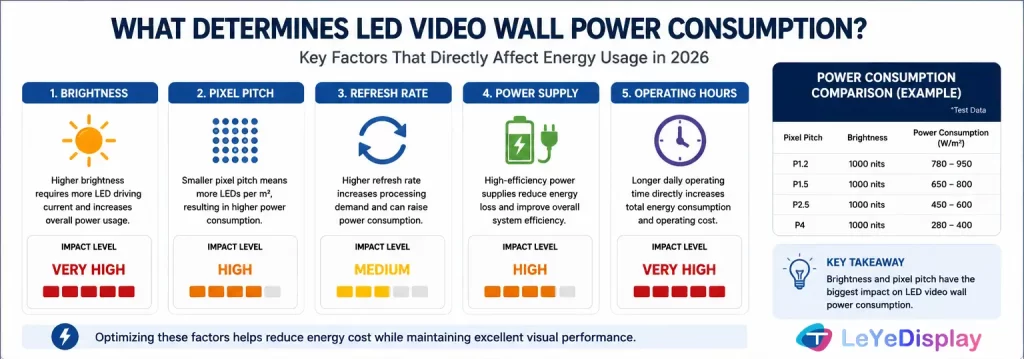
Many buyers incorrectly assume that LED power usage depends only on screen size.
In reality, multiple technical factors directly affect electricity consumption.
Power consumption is only one part of the LED video wall selection process.
Factors such as pixel pitch, brightness, refresh rate, display technology, operating environment, and long-term maintenance requirements all influence the overall performance and total cost of ownership of an LED display project.
For a complete overview of how these factors work together, see our LED Video Wall Buying Guide.
Brightness Is One of the Biggest Power Factors
Brightness has a major impact on overall power usage.
Higher brightness requires:
- More LED driving current
- Increased heat generation
- Higher power supply load
For example:
| Application | Typical Brightness |
|---|---|
| Conference Room | 600–800 nits |
| Retail Display | 1000–2500 nits |
| Outdoor Billboard | 5000–7000+ nits |
Many projects are significantly over-specified.
Choosing excessive brightness can dramatically increase the LED video wall power consumption 2026 calculation without improving real-world viewing quality.
👉 Read our detailed guide on LED video wall brightness guide 2026.
Pixel Pitch Also Affects Energy Usage
Fine-pitch LED displays typically contain more LEDs per square meter.
This means:
- Higher pixel density
- More driver IC activity
- Increased power demand
For example:
| Pixel Pitch | Relative Power Consumption |
|---|---|
| P1.2 | Very High |
| P1.5 | High |
| P2.5 | Medium |
| P4 | Lower |
Ultra-fine pitch displays can deliver excellent image quality, but they usually consume more power than larger-pitch systems.
The LED video wall power consumption 2026 trend is therefore closely connected to display resolution choices.
👉 Learn more in our guide on how to choose LED video wall pixel pitch.
Refresh Rate Influences Power Efficiency
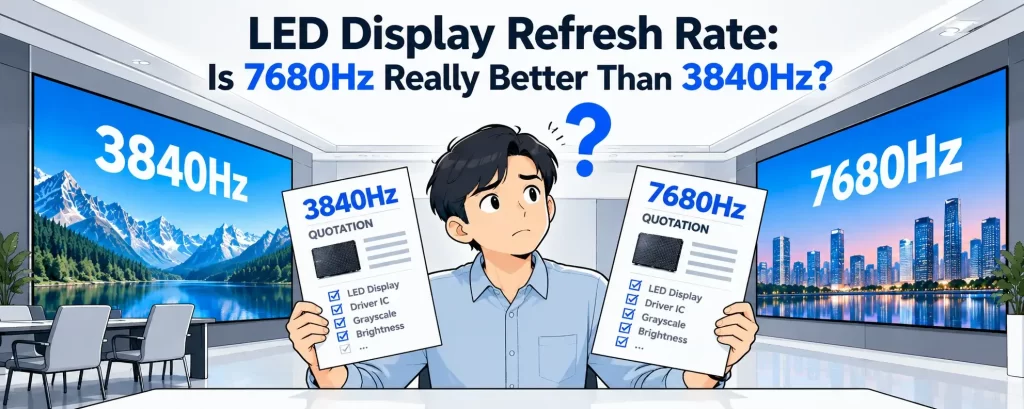
High refresh rates improve camera performance and visual smoothness.
However, higher refresh rate configurations may also increase processing demand and power usage.
Most commercial projects today use:
- 1920Hz
- 3840Hz
- 7680Hz
In many standard indoor applications, 3840Hz already provides excellent visual performance while maintaining reasonable efficiency.
👉 Read our analysis: is 3840Hz refresh rate enough for LED video walls.
Power Supply Efficiency Matters More Than Many Buyers Realize
Power supply quality directly affects operating efficiency.
High-efficiency power supplies can:
- Reduce heat generation
- Improve stability
- Lower long-term electricity cost
- Extend component lifespan
Low-quality power systems often waste energy through unnecessary heat conversion.
Professional engineering-focused suppliers usually prioritize higher-efficiency power architecture for long-term reliability.
In many commercial installations, poor power architecture also becomes one of the most common cheap LED wall problems, often leading to higher operating costs, thermal stress, and long-term reliability issues.
Smart Brightness Control Can Reduce Energy Consumption
Modern LED systems increasingly support automatic brightness adjustment.
This allows displays to adapt based on:
- Ambient lighting
- Day/night conditions
- Indoor environment changes
Smart brightness systems can significantly reduce the LED video wall power consumption 2026 impact in outdoor and retail applications.
For many commercial projects, automatic brightness control can reduce operating cost without reducing viewing quality.
Indoor vs Outdoor LED Power Consumption
Outdoor LED displays generally consume far more electricity because they require:
- Higher brightness
- Weather protection systems
- Stronger cooling performance
Typical outdoor systems may use:
- 2–4× more power than indoor displays
This becomes especially important for:
- Highway billboards
- Stadium displays
- DOOH advertising
- Transportation hubs
Buyers should carefully evaluate operating schedules before selecting brightness specifications.
How Operating Hours Affect Long-Term Cost
Daily operating time has a major effect on total ownership cost.
For example:
| Daily Operation | Annual Energy Impact |
|---|---|
| 4 Hours/Day | Low |
| 8 Hours/Day | Medium |
| 16+ Hours/Day | High |
The LED video wall power consumption 2026 discussion becomes especially important for displays operating continuously.
Control rooms and outdoor advertising systems often run nearly 24/7.
Common Mistakes That Increase LED Electricity Cost
Many projects waste significant energy because of incorrect specification planning.
Common mistakes include:
- Over-specifying brightness
- Using ultra-fine pitch unnecessarily
- Selecting oversized power systems
- Ignoring automatic brightness control
- Using low-efficiency power supplies
- Running displays at maximum brightness continuously
In many projects, proper engineering optimization can reduce total operating cost substantially.
How Energy Efficiency Affects ROI
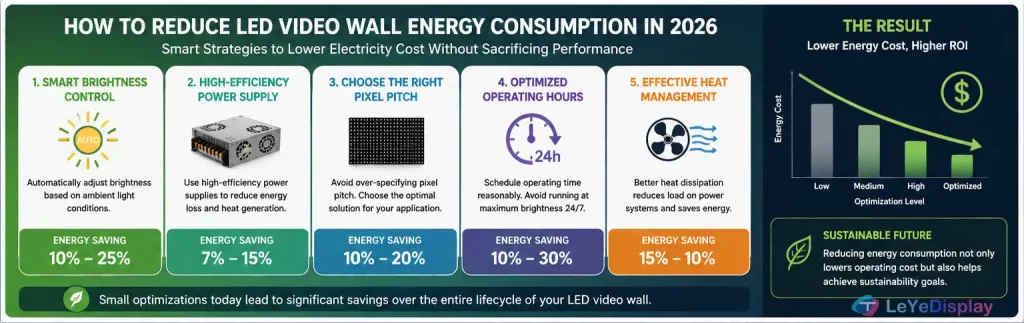
Energy efficiency now plays a major role in LED investment decisions.
The LED video wall power consumption 2026 topic is increasingly connected to:
- Long-term profitability
- Sustainability goals
- Commercial operating budgets
- Government energy regulations
For rental companies and large commercial operators, lower energy consumption can significantly improve project ROI over several years.
How Global Supply Chain Changes Are Affecting LED Efficiency
In 2026, manufacturers are under growing pressure to improve energy efficiency while controlling production cost.
At the same time, rising semiconductor and PCB material prices are affecting power system design.
Recent LED industry market data suggests manufacturers are investing more heavily in efficient driver ICs and optimized power architecture.
👉 Read our latest analysis on China LED supply chain price surge 2026.
How to Choose an Energy-Efficient LED Supplier
A professional LED supplier should help buyers optimize more than only display specifications.
Engineering-focused suppliers can help clients:
- Reduce unnecessary brightness
- Optimize power architecture
- Improve thermal efficiency
- Select suitable refresh rates
- Lower long-term operating cost
- Improve system reliability
The best LED projects balance:
- Visual performance
- Energy efficiency
- Reliability
- Long-term operating value
The LED video wall power consumption 2026 discussion is becoming increasingly important across nearly every commercial LED application.
As electricity cost continues rising globally, buyers can no longer focus only on initial display pricing.
Instead, successful LED projects now depend on:
- Smart brightness planning
- Efficient power systems
- Appropriate pixel pitch selection
- Intelligent operating strategies
- Long-term lifecycle optimization
Companies that optimize these factors correctly can significantly reduce operating expense while maintaining excellent visual performance.
Planning an Energy-Efficient LED Video Wall Project?
Our engineering team helps global clients optimize LED display performance while reducing unnecessary operating cost.
We can help you:
- ✔ Optimize brightness selection
- ✔ Improve energy efficiency
- ✔ Reduce long-term electricity cost
- ✔ Select suitable refresh rates
- ✔ Improve system reliability
Contact our team for a customized proposal and technical consultation. Our engineering team will respond within 24 hours with a tailored LED solution and project recommendations.