LED video wall brightness 2026 is no longer a simple question of choosing the highest nit value available. In professional AV projects, brightness selection directly affects power consumption, viewing comfort, camera compatibility, and long-term system reliability.
As LED technology advances toward fine-pitch COB, MiniLED, and AI-controlled brightness management, engineers and buyers must rethink how brightness should be specified for real-world environments—not just datasheets.
This guide explains how to choose LED video wall brightness in 2026 based on engineering standards, application scenarios, and measurable performance indicators, helping you avoid both over-specification and under-performing installations.
Why LED Video Wall Brightness Matters More in 2026
In earlier LED generations, brightness was often used to compensate for poor contrast and low gray scale. In 2026, that approach no longer applies.
Modern LED video wall systems now feature:
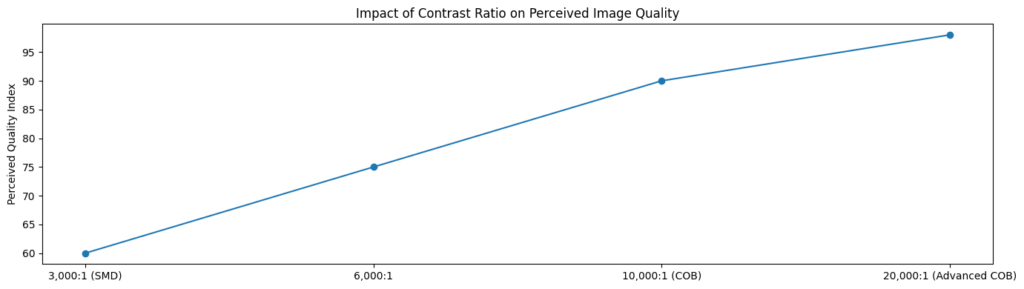
- Higher native contrast ratios (up to 20,000:1 with COB)
- Improved low-gray performance (16–18 bit processing)
- Smarter power management through common-cathode and AI dimming
As a result, excessive brightness often reduces image quality, increases glare, and wastes energy—especially in indoor environments.
How to Choose LED Video Wall Brightness 2026 (Engineering Standards)
When selecting LED video wall brightness 2026, engineers should evaluate brightness together with environment, viewing distance, and operational duty cycle.
1. Indoor Professional Environments
Typical applications:
Conference rooms, control centers, corporate lobbies, broadcast studios
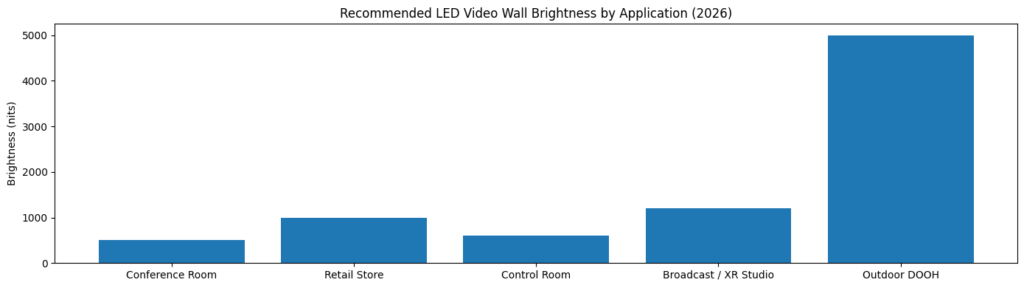
- Recommended brightness: 500–800 nits
- Why: Controlled lighting environments do not benefit from higher brightness
- Engineering risk of over-brightness: Eye fatigue, Reduced contrast perception, Higher power consumption and heat
In most indoor projects, brightness above 1000 nits provides no visual benefit.
2. Semi-Bright Public Spaces
Typical applications:
Retail stores, airports, exhibition halls
- Recommended brightness: 800–1200 nits
- Key factors: Ambient light variation, Viewing angles, Content readability
Balanced brightness ensures visibility without overpowering the surrounding space.
3. Outdoor and High-Ambient-Light Applications
Typical applications:
Outdoor DOOH, stadiums, transportation hubs
- Recommended brightness: 3000–6000+ nits
- Critical requirements: High contrast under sunlight, Automatic brightness adjustment, Power and thermal control
Outdoor LED video walls rely on brightness as a necessity, not a marketing metric.
Brightness is one of the most important specifications in LED display selection, but it should never be evaluated in isolation.
Professional buyers typically assess brightness together with pixel pitch, refresh rate, display technology, power consumption, lifespan, installation environment, and long-term maintenance requirements before making a final decision.
For a complete framework covering all major purchasing considerations, explore our LED Video Wall Buying Guide.
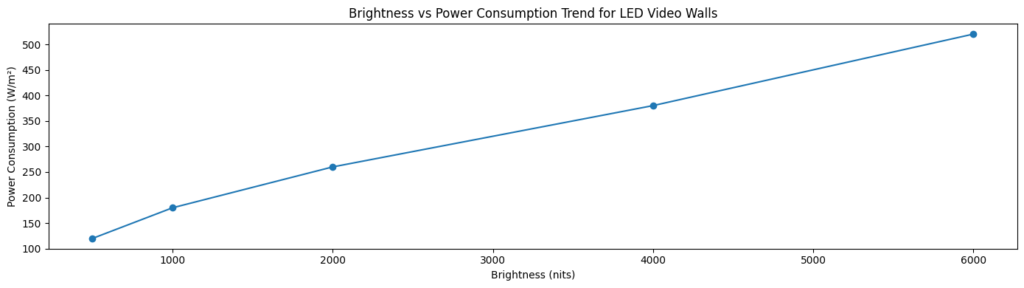
Brightness vs Power Consumption: The Hidden Cost
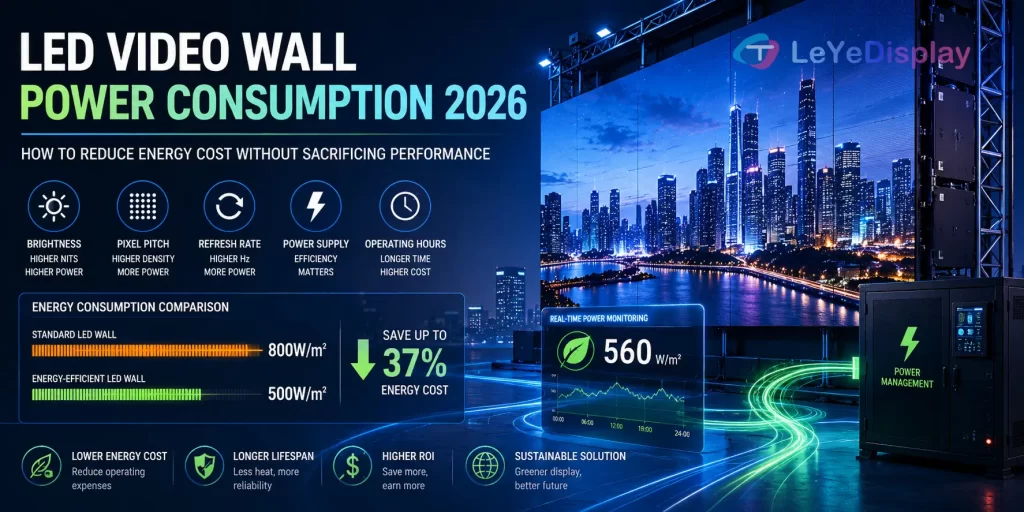
Higher brightness always increases power draw.
From engineering measurements:
- 600 nits ≈ 120–150 W/m²
- 1000 nits ≈ 180–220 W/m²
- 3000 nits ≈ 350+ W/m²
In 24/7 environments, overspecifying brightness can increase annual operating costs by 30–40%, without improving user experience.
This is why modern LED video wall brightness 2026 strategies emphasize:
- Common-cathode drivers
- Dynamic brightness control
- Content-aware luminance scaling
Brightness, Contrast, and Perceived Image Quality
Brightness alone does not define clarity.
Key engineering relationship:
- Higher contrast + moderate brightness
→ Better perceived image quality than - High brightness + low contrast
COB LED technology excels here by reducing light leakage between pixels, allowing lower brightness to deliver superior black levels and depth.
Common Brightness Mistakes in LED Video Wall Projects
Even in 2026, engineers still encounter recurring mistakes:
- Copying outdoor brightness specs for indoor use
- Ignoring camera requirements for broadcast spaces
- Assuming “brighter = higher quality”
- Failing to calculate total cost of ownership (TCO)
Correct LED video wall brightness 2026 selection always starts from environment—not brochure claims.
Practical Brightness Selection Table (Engineering Reference)
| Application | Recommended Brightness | Engineering Priority |
|---|---|---|
| Conference Room | 500–600 nits | Eye comfort, contrast |
| Control Room | 600–800 nits | 24/7 stability |
| Retail / Lobby | 800–1000 nits | Visibility + aesthetics |
| Broadcast Studio | 600–800 nits | Camera-friendly |
| Outdoor DOOH | 4000–6000 nits | Sunlight readability |
Engineering Insight: Why Lower Brightness Often Performs Better
In real deployments, systems operating at 60–70% of maximum brightness show:
- Longer LED lifespan
- Lower failure rates
- More stable color calibration
Professional solution providers such as LeyeDisplay, acting as an engineering solution partner, increasingly design LED systems around application-optimized brightness rather than peak output values.
Final Verdict: LED Video Wall Brightness 2026 Done Right
In 2026, understanding LED video wall brightness 2026 from an engineering perspective helps buyers avoid over-specification, reduce energy waste, and ensure long-term ROI.
Brightness should always be selected based on:
- Environment lighting
- Viewing distance
- Operating hours
- Power efficiency goals
When specified correctly, brightness becomes a performance enhancer—not a liability.