Installing an LED video wall involves much more than mounting cabinets onto a wall. Structural support, electrical capacity, signal routing, ventilation, maintenance access, and site conditions all affect whether the finished system can operate safely and reliably.
Understanding LED video wall installation requirements before production helps system integrators and project owners avoid dimensional conflicts, unexpected construction work, and costly installation delays.
Quick Answer: Before installing an indoor LED video wall, confirm the final display dimensions, supporting structure, mounting depth, electrical supply, signal and control system, ventilation conditions, maintenance access, and commissioning responsibilities. These eight areas should be reviewed together rather than independently.
This guide focuses on fixed indoor LED installations in meeting rooms, control centers, auditoriums, corporate environments, and similar commercial spaces.
Why Installation Planning Matters Before Ordering an LED Wall
An LED display can meet every technical specification on a quotation and still be unsuitable for the installation site.
For example, a cabinet may fit the available wall opening, but the supporting structure, cables, and maintenance method may require additional space.
Similarly, the LED wall may have sufficient resolution and brightness, but the available electrical circuits or control infrastructure may not support the proposed configuration.
Understanding LED video wall installation requirements early makes these problems easier to solve during project planning than after equipment arrives.
A practical review of LED video wall installation requirements should therefore begin before cabinet dimensions, mounting structures, and electrical layouts are finalized.
1. Site Survey and Final Display Dimensions
The first step in reviewing LED video wall installation requirements is confirming the physical installation environment.
A site survey should establish the available width, height, depth, wall condition, access routes, and surrounding architectural features.
Confirm the Actual Installation Area
Record the following information:
- Available wall width and height
- Ceiling and floor clearances
- Wall openings and recessed areas
- Surrounding doors, columns, and decorative finishes
- Equipment delivery and access routes
- Potential obstructions near the display
Do not assume that architectural drawings always reflect the final site conditions.
Measurements should be verified before production, particularly when the LED display must fit inside a recessed opening.
Display dimensions should also be evaluated against viewing positions and the intended visual tasks. The AVIXA Display Image Size standard provides an industry framework for planning display image size and viewing distances in audiovisual environments.
Match Cabinet Dimensions to the Project
LED video walls are assembled from cabinets or modules with fixed dimensions.
The final screen size depends on the selected cabinet configuration.
For example, if a project uses 600 × 337.5 mm cabinets, a layout of six cabinets horizontally and four vertically produces a display measuring 3600 × 1350 mm.
However, this represents the nominal assembled display size, not necessarily the complete construction opening required for mounting and finishing.
The final design must also account for installation tolerances and any necessary structural or service clearances.
Project check: Obtain a dimensioned cabinet layout drawing before approving the architectural opening.
2. Structural Support and Mounting Design
Structural support is one of the most critical LED video wall installation requirements, as the mounting system must safely carry the complete installed load.
Depending on the application, the display may be mounted on a structural wall, a steel frame, a floor-supported structure, or a specially designed mounting system.
Evaluate the Supporting Surface
Not every wall can directly support an LED display.
The project team should verify:
- Wall construction and structural capacity
- Total cabinet and mounting-system weight
- Load distribution and fixing points
- Anchor and bracket suitability
- Required installation tolerances
- Applicable local building requirements
Decorative wall panels and lightweight partitions should not be treated as structural supports without verification.
The final mounting design should be reviewed by appropriately qualified structural professionals.
Plan the Steel Structure Before Production
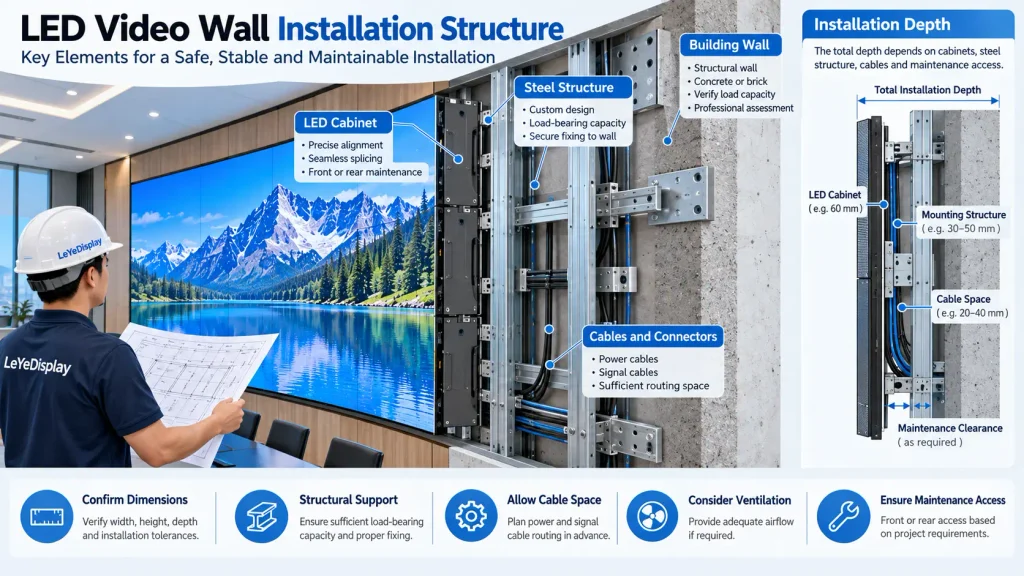
Steel structures are often customized to the display layout and site conditions.
Their dimensions can influence the overall installation depth, cabinet alignment, and maintenance access.
A common mistake is to finalize the LED screen size without considering the mounting structure behind it.
Project check: Confirm structural drawings, load requirements, fixing methods, and cabinet attachment details before manufacturing the mounting system.
3. Installation Depth and Recessed Wall Planning
Installation depth is particularly important for wall-mounted and recessed LED displays.
The required space is not determined by cabinet thickness alone.
A complete installation may involve:
- LED cabinet depth
- Mounting brackets or steel structure
- Power and signal cable routing
- Connector clearance
- Installation and adjustment tolerances
- Maintenance access requirements
- Ventilation provisions where necessary
Recessed Installations Require Additional Coordination
For a recessed LED wall, the available opening must accommodate the complete mounting arrangement.
For example, a recess that appears deep enough for a 60 mm cabinet may still be unsuitable if the steel structure and cable connections require additional space.
Architectural finishing can also restrict access to the edges of the display.
These details should be confirmed using coordinated installation drawings rather than cabinet specifications alone.
When evaluating LED video wall installation requirements, recessed depth should be treated as a complete system dimension.
Project check: Verify the available depth against the cabinet, structure, cable routing, ventilation needs, and intended maintenance method.
4. Electrical Supply and Power Distribution
Electrical planning is one of the most important LED video wall installation requirements, particularly for large displays operating over extended periods.
An LED video wall typically operates through multiple power supplies distributed across cabinets or modules.
The electrical system must support the display’s expected operating conditions.
Understand Maximum and Typical Power Consumption
LED display specifications often provide two power figures:
Maximum power consumption represents the specified upper operating demand under defined conditions.
Typical or average power consumption describes expected usage under particular operating assumptions.
These values should not be treated as interchangeable.
For a deeper explanation of maximum and typical power ratings, refer to our LED display power consumption guide before calculating the project’s electrical requirements.
Electrical circuits, protective devices, and distribution equipment must be designed for the appropriate calculated load, taking into account manufacturer requirements and applicable electrical regulations.
For example, a 10 m² display rated at 600 W/m² maximum power has a stated maximum display demand of 6 kW before accounting for any additional system equipment.
This is a planning calculation, not a complete electrical design.
Confirm the Electrical Infrastructure
Important considerations include:
- Available supply voltage and frequency
- Total connected electrical load
- Circuit capacity and distribution
- Cable sizing and routing
- Protective devices
- Protective earthing and bonding
- Power distribution equipment
- Emergency shutdown requirements where applicable
Electrical installation and protection should be designed and verified by qualified personnel under local regulations.
Project check: Obtain the supplier’s maximum power requirements and power-distribution recommendations before electrical work begins.
5. Signal Cabling and Control System Planning
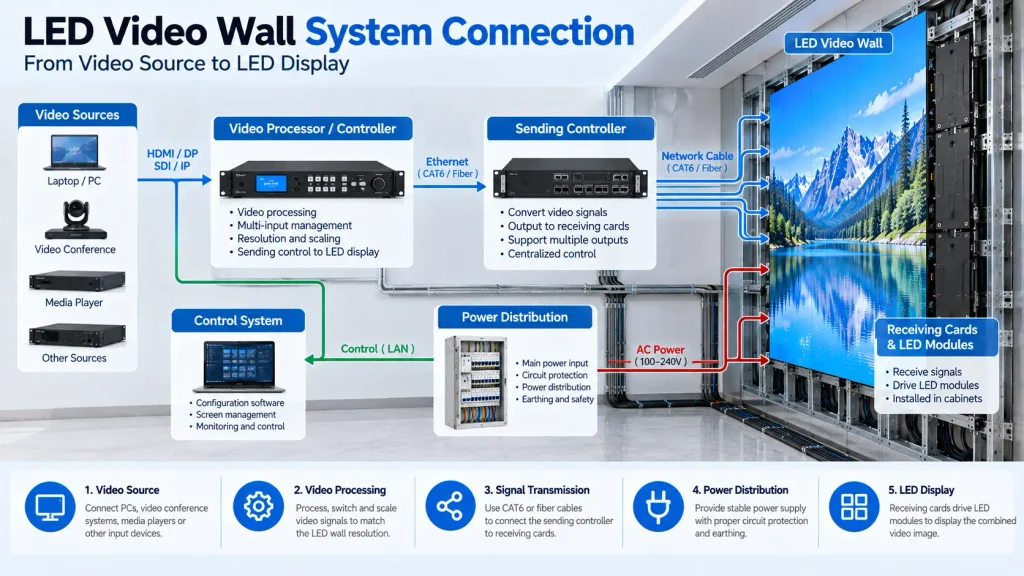
Reliable signal transmission is another essential part of LED video wall installation requirements, connecting video sources, controllers, receiving cards, and LED modules.
Depending on the system, this may involve a video processor, sending controller, receiving cards, network cabling, and control software.
Confirm the Complete Signal Chain
A typical arrangement may be:
Video Source → Video Processor / Controller → Receiving Cards → LED Modules
Some controllers integrate video processing and sending functions, so separate devices are not always necessary.
The system architecture depends on display resolution, input requirements, control functions, and equipment selection.
Plan Cable Routing Before Installation
Confirm:
- Video source locations
- Controller installation location
- Signal cable routes
- Required cable lengths
- Cable type and transmission limits
- Redundancy requirements
- Separation from electrical interference sources
- Accessibility for troubleshooting
Cable pathways should be coordinated with the mounting structure and architectural finishes.
For larger or mission-critical installations, signal redundancy and backup arrangements may be appropriate.
Project check: Request a signal connection diagram and confirm the controller’s output capacity against the final LED wall resolution.
6. Heat Dissipation and Ventilation
Heat dissipation is another important consideration when reviewing LED video wall installation requirements, because LED displays generate heat during operation.
Although modern indoor LED systems can be relatively efficient, thermal conditions still affect component reliability and operating stability.
Ventilation requirements depend on cabinet construction, power consumption, installation method, ambient temperature, and manufacturer specifications.
Evaluate the Operating Environment
Important factors include:
- Ambient temperature
- Air circulation
- Cabinet ventilation design
- Heat accumulation behind the display
- Nearby heating or cooling equipment
- Continuous operating hours
- Manufacturer-specified temperature limits
A display installed on an open mounting frame may have different thermal conditions from one enclosed inside a decorative wall.
Recessed installations deserve particular attention because the surrounding structure can restrict airflow.
Avoid Assuming Every LED Wall Needs the Same Ventilation Gap
There is no universal rear ventilation clearance suitable for every LED display.
Some systems are specifically designed for shallow, front-service installations, while others require additional airflow or service space.
The correct arrangement should follow the manufacturer’s thermal and installation requirements.
Project check: Confirm the expected operating temperature and ventilation strategy before closing the surrounding architectural structure.
7. Front Maintenance vs Rear Maintenance Access
Maintenance access should be decided during project planning, not after installation.
An LED wall may require future access to modules, receiving cards, power supplies, and internal connections.
The appropriate servicing method depends on cabinet design and site conditions.
Front Maintenance
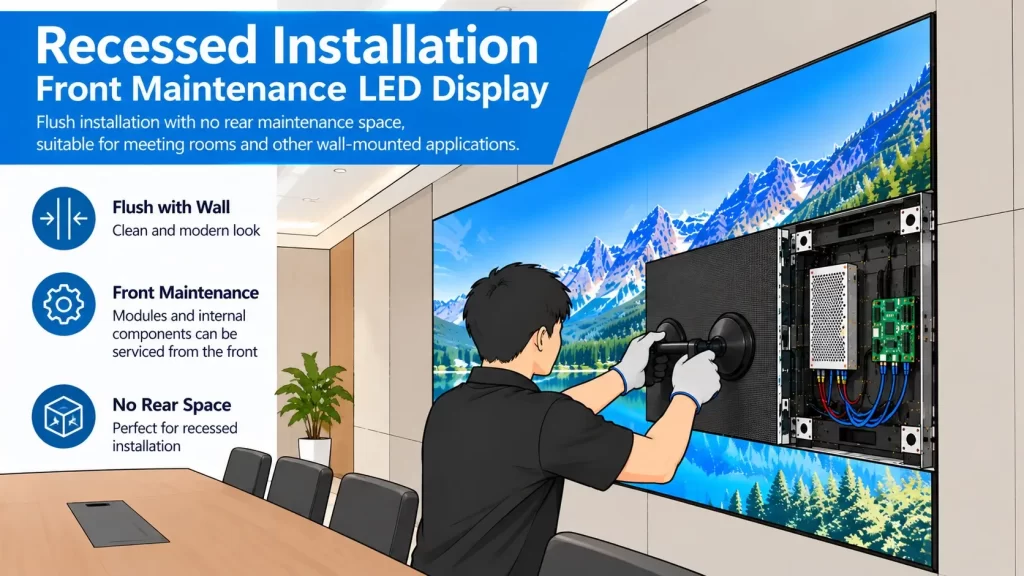
Front-maintenance LED displays allow designated components to be accessed from the viewing side.
This approach can be particularly useful for:
- Wall-mounted displays
- Recessed installations
- Meeting rooms
- Control centers
- Architectural spaces without rear service corridors
However, buyers should verify which components are genuinely front-accessible and what tools or removal procedures are required.
Rear Maintenance
Rear-maintenance designs require sufficient access behind the screen for the relevant service operations.
They may be suitable for installations with dedicated service space, accessible structural frameworks, or other permanent rear-access arrangements.
The important question is not which maintenance method is universally better.
For a more detailed comparison, see our guide to front maintenance vs rear maintenance LED displays, including how service access affects recessed and wall-mounted installations.
It is whether the display remains serviceable after the surrounding construction is complete.
A proper assessment of LED video wall installation requirements must include long-term component access, not just initial cabinet installation.
Project check: Confirm that modules, power supplies, receiving cards, and connections can be serviced safely in the final installed configuration.
8. Installation Safety, Testing, and Commissioning
Meeting LED video wall installation requirements also involves safety inspections, system testing, and commissioning—not simply mounting the cabinets.
The completed system also requires electrical verification, signal configuration, image adjustment, and acceptance testing.
Installation Safety
The project team should establish appropriate procedures for:
- Equipment handling and lifting
- Working at height where applicable
- Structural fixing and inspection
- Electrical isolation
- Cable protection
- Access to serviceable components
- Coordination with other construction activities
Applicable safety requirements vary by country, project type, and installation environment.
Qualified installers and relevant engineering professionals should be involved where required.
System Commissioning
After installation, the team should verify:
- Cabinet alignment and screen flatness
- Power distribution and electrical operation
- Signal connectivity
- Controller configuration
- Correct display resolution
- Brightness and color uniformity
- Calibration status
- Image stability
- Functional maintenance access
- Final documentation and handover
Commissioning should be performed under realistic operating conditions rather than relying only on a brief power-on test.
Project check: Agree on the testing procedure, acceptance criteria, and handover responsibilities before installation begins.
Example: Planning a Recessed LED Video Wall
Consider a hypothetical corporate meeting-room project.
The architectural design includes a recessed opening intended for a fixed indoor LED display.
The initial project brief specifies the required screen dimensions, pixel pitch, and visual appearance.
However, the recess depth has not yet been checked against the complete mounting arrangement.
Before confirming the order, the integrator reviews the cabinet dimensions, supporting frame, cable routing, and maintenance method.
The review identifies that the proposed rear-maintenance configuration would not provide suitable access after the decorative wall is completed.
The team therefore evaluates a compatible front-maintenance configuration and adjusts the installation details accordingly.
This example illustrates an important lesson:
A display that physically fits the opening is not necessarily an installable and maintainable system.
Early coordination between the display supplier, system integrator, structural team, and interior contractor can prevent avoidable changes during installation.
For a practical example, explore our recessed LED video wall solution, which shows how an existing wall opening, structural depth, cable routing, and front maintenance access were coordinated within a space-constrained project.
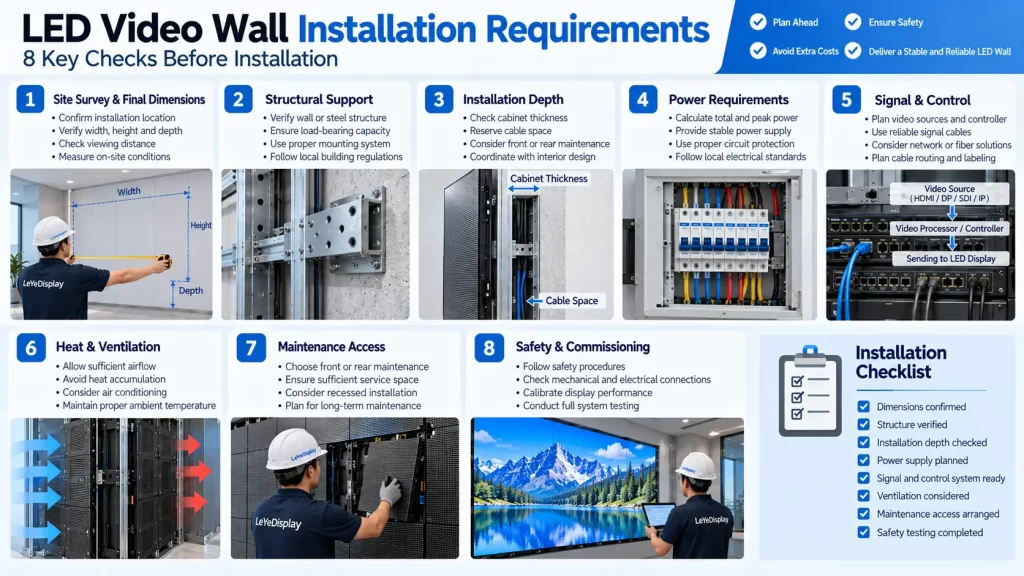
LED Video Wall Installation Requirements Checklist
Before production and installation, use the following checklist to confirm project readiness.
| Checkpoint | What Must Be Confirmed |
|---|---|
| Site dimensions | Final width, height, depth, and access conditions |
| Cabinet layout | Cabinet quantity, screen size, resolution, and alignment |
| Structural support | Load capacity, fixing method, and approved mounting design |
| Installation depth | Cabinet, structure, cables, and required clearances |
| Electrical system | Maximum load, distribution, protection, and earthing |
| Control system | Video sources, controller capacity, signal routing |
| Ventilation | Ambient conditions, heat dissipation, and manufacturer requirements |
| Maintenance | Front/rear access and component replacement procedures |
| Commissioning | Testing, calibration, acceptance, and documentation |
If any of these items remain unclear, resolve them before finalizing the installation design.
A documented review of LED video wall installation requirements helps reduce assumptions between suppliers, installers, and project owners.
Common LED Wall Installation Mistakes to Avoid
Even experienced project teams can encounter installation problems when responsibilities are not clearly defined.
Finalizing Cabinet Dimensions Before Checking the Site
The screen layout should be coordinated with the actual installation environment, including architectural and structural restrictions.
Ignoring the Supporting Structure
Cabinet thickness alone does not determine the full installation depth or mounting requirements.
Designing Electrical Circuits Around Average Power Only
Electrical planning should consider the appropriate maximum demand, equipment specifications, and applicable safety requirements.
Leaving Signal Routing Until the Final Installation Stage
Cable routes, controller locations, and transmission requirements should be planned before the surrounding construction is closed.
Forgetting Future Maintenance
A screen may operate correctly on installation day but become difficult to repair if access is blocked by architectural finishes.
These mistakes are preventable when LED video wall installation requirements are reviewed as part of the complete project design.
Conclusion: Plan the Installation Before Finalizing the LED Display
A successful LED video wall project depends on more than display specifications.
Structural design, available space, electrical infrastructure, control systems, ventilation, maintenance, and commissioning must work together.
For system integrators and project buyers, reviewing these conditions before production helps improve installation efficiency and reduce unexpected project changes.
The most effective approach is to confirm LED video wall installation requirements before finalizing the cabinet configuration, mounting structure, and delivery scope.
A properly planned installation is easier to build, operate, maintain, and support throughout the system’s service life.
For additional guidance on LED screen selection, technical specifications, and purchasing decisions, visit our LED Video Wall Buying Guide.
Frequently Asked Questions
What are the basic requirements for installing an LED video wall?
The basic requirements include verified site dimensions, suitable structural support, adequate electrical supply, compatible control equipment, planned cable routing, appropriate ventilation, and safe maintenance access. Commissioning and acceptance procedures should also be defined.
How much space is needed behind an indoor LED wall?
There is no universal clearance requirement. The necessary depth depends on cabinet design, mounting structure, cabling, ventilation, and maintenance method. Front-maintenance systems may reduce the need for rear service access, but the manufacturer’s installation specifications should determine the final arrangement.
Does an LED video wall need a steel structure?
Not every LED wall requires a custom steel structure. Some systems use engineered wall-mounting brackets or other approved mounting arrangements. The appropriate support method depends on display weight, site conditions, and structural design.
How much electrical power does an LED video wall require?
Power demand depends on screen area, LED technology, brightness, and product specifications. For initial calculations, multiply the display area by the manufacturer’s maximum power rating per square meter, then account for additional equipment and electrical design requirements. Final circuit design should be completed by qualified personnel.
Can an LED video wall be installed inside a recessed wall?
Yes, provided the opening accommodates the complete installation system, including cabinets, structure, cables, thermal requirements, and maintenance access. Recessed installations should be coordinated with the architectural design before production.