When you request an LED display quotation, sending only “P2.5 LED screen, 20 square meters” is usually not enough.
An LED display is not priced only by the number of square meters. The final configuration can also depend on the application, viewing distance, installation environment, cabinet layout, maintenance access, control system, shipping destination, and project schedule.
The good news is that you do not need to be an LED engineer before contacting a manufacturer.
You simply need to provide enough project information for the manufacturer to understand what you are trying to build.
A well-prepared LED display quotation request helps the supplier recommend a practical configuration instead of guessing what you need.
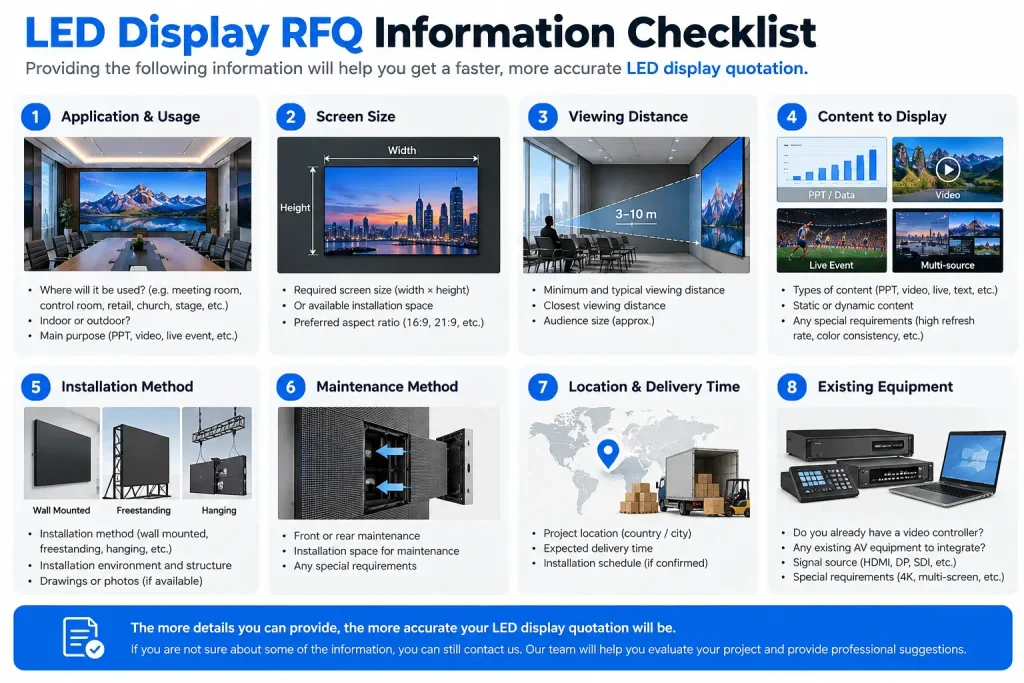
Quick Answer: What Should You Send to an LED Manufacturer?
For most projects, start your LED display quotation request with these key details:
- Application: meeting room, control room, retail, advertising, stage, lobby, etc.
- Indoor or outdoor environment
- Screen size: required display size or available installation area
- Viewing distance: especially the closest important viewing position
- Content: presentation, text, video, live camera, dashboard, advertising, or mixed content
- Installation method: wall-mounted, hanging, ground-supported, structure-mounted, or rental
- Maintenance access: front, rear, or not yet decided
- Project location: country and city
- Required delivery date
- Site photos, drawings, or measurements, if available
These details give a manufacturer a much better starting point for an LED display quote than a product name or pixel pitch alone. Current buyer-oriented RFQ guidance from LED manufacturers similarly emphasizes application, dimensions, viewing conditions, installation, service access, content, destination, and schedule.
1. Start With the Application, Not the Pixel Pitch
One of the most common mistakes in an LED display quotation request is starting with a specification such as:
“Please quote P2.5.”
That tells the manufacturer very little about the actual project.
A P2.5 display could be used in a corporate meeting room, retail store, control room, stage, church, lobby, or outdoor environment. Those projects can require very different display configurations.
Instead, describe the project first.
For example:
“We need an indoor LED video wall for a corporate meeting room. The screen will mainly display PowerPoint presentations, spreadsheets and video conferencing content. The closest viewing distance is approximately 2.5 meters.”
That single sentence gives the manufacturer useful information about the application, content and viewing environment.
You can still specify your preferred pixel pitch if you already have one. However, if you are not sure, it is often better to provide the project requirements and ask the manufacturer to recommend suitable options.
2. Provide the Screen Size — But Give More Than One Measurement
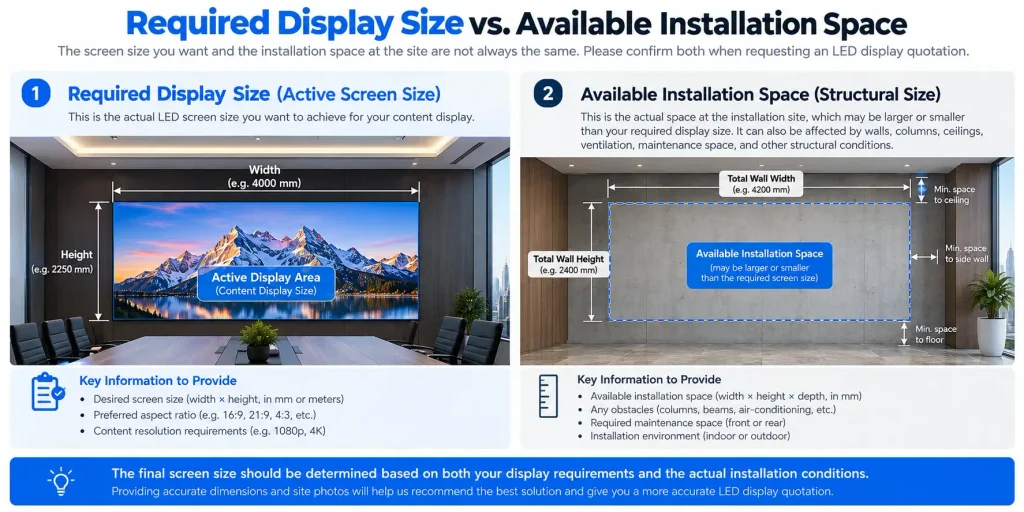
Screen size is obviously important for an LED display quotation, but there is an important distinction between:
Required display size
and
Available installation space.
For example:
Required display area: 4,800 × 2,700 mm
Available wall opening: approximately 5,000 × 3,000 mm
This gives the manufacturer room to determine whether a standard cabinet configuration can fit the available space.
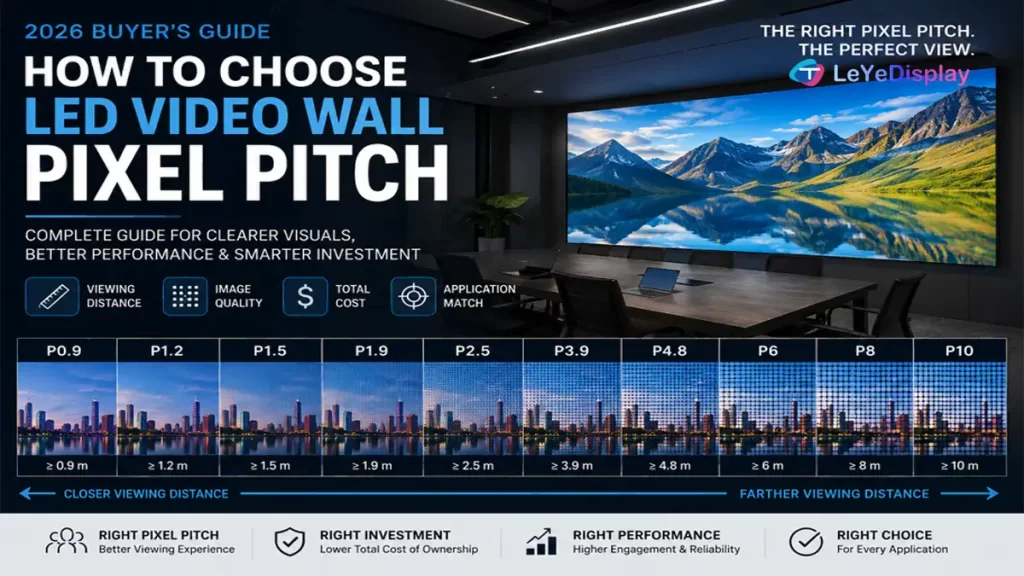
For a broader overview of how screen size, viewing distance, pixel pitch and budget work together, see our LED Video Wall Buying Guide.
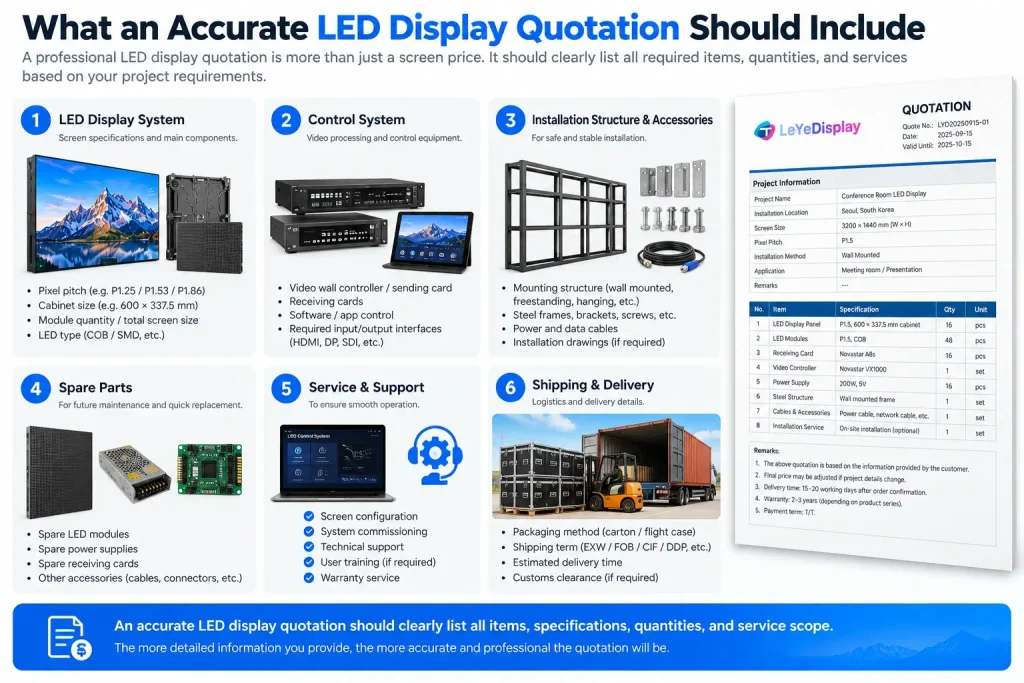
LED displays are modular products. Cabinet dimensions and module layouts can affect the final width, height and resolution.
For example, LeYeDisplay’s current indoor COB platforms use different cabinet formats, including a 600 × 337.5 mm native 16:9 cabinet and a 640 × 480 mm cabinet.
That is why you should avoid assuming that the final screen must match a requested size down to the last millimeter before the manufacturer checks the cabinet layout.
If possible, provide:
- Required width
- Required height
- Available wall width
- Available wall height
- Available depth
- Any columns, beams or openings
- A simple drawing or sketch
If the project involves a recessed wall or an unusual opening, photos become especially useful.
3. Tell the Manufacturer the Viewing Distance
Viewing distance is one of the most useful pieces of information in an LED display quotation request.
The manufacturer can use it together with screen size and content requirements to evaluate the appropriate pixel pitch. If you want to understand how viewing distance affects pixel pitch in more detail, see our guide to LED video wall pixel pitch.
You do not necessarily need to calculate the pixel pitch yourself.
Instead, provide:
- Closest viewing distance
- Typical viewing distance
- Farthest viewing distance, if relevant
For example:
Closest viewer: 2.5 m
Typical viewing distance: 4 m
Farthest viewer: 8 m
This is particularly important for fine-pitch indoor LED projects where people may stand close to the screen.
LeYeDisplay’s current COB products, for example, position different pixel-pitch options according to viewing distance, screen dimensions and content requirements rather than treating pixel pitch as an isolated specification.
4. Explain What Will Be Displayed
Content is often overlooked when preparing an LED display quotation.
But “video” is not the same requirement as:
- PowerPoint presentations
- Excel spreadsheets
- Small text
- Live camera feeds
- Control-room dashboards
- Digital advertising
- Sports content
- Video conferencing
If the display will show detailed text or computer interfaces at close range, tell the manufacturer.
If cameras will capture the LED wall, mention that as well.
The content helps the supplier understand whether factors such as pixel pitch, refresh rate, grayscale performance and processing should receive additional attention.
5. Explain How the Display Will Be Installed
Installation conditions can significantly affect the scope of an LED display quotation.
Tell the supplier whether the screen will be:
- Wall-mounted
- Recessed
- Hanging
- Ground-supported
- Installed on a steel structure
- Integrated into an existing architectural opening
- Used as a rental display
If possible, provide photos of the installation area.
A photo can reveal information that is difficult to describe in an email:
- Wall construction
- Available depth
- Columns
- Ceiling height
- Existing structure
- Cable routes
- Power locations
- Access restrictions
This is particularly important for custom-size projects. Recent industry RFQ guidance also emphasizes site photos, drawings and access conditions because these can affect the final configuration and quotation scope.
6. Tell the Manufacturer How the Screen Can Be Serviced
Maintenance access should not be left until installation day.
For a wall-mounted indoor LED video wall, there may be very little space behind the display. In that situation, front service may be necessary.
If there is sufficient access behind the screen, rear service may also be practical.
If you are unsure, simply say:
“Maintenance method not decided. Please recommend based on the site.”
This is enough for the manufacturer to evaluate the options.
LeYeDisplay’s TQW Series Micro COB LED platform, for example, is designed around front-service indoor installations, while different products and project conditions can require different access arrangements.
For an accurate LED display quotation, the important thing is not that you already know the answer. It is that you tell the manufacturer about the physical constraints.
7. Provide the Project Location and Required Delivery Date
Two otherwise identical LED displays can have different project costs depending on where they are being delivered and when they are needed.
Include:
Destination
City + Country
Required delivery date
For example: “The display needs to arrive before December 15.”
If installation is involved, clarify whether you need:
- Equipment only
- Remote installation guidance
- Installation drawings
- On-site installation support
- Complete installation
This prevents the supplier from preparing an LED display quotation with a scope that does not match your project.
8. Tell the Manufacturer What You Already Have
You may not need a complete technical specification before requesting an LED display quotation.
Instead, tell the supplier what is already available.
For example:
Existing video processor: yes
Existing steel structure: yes
Power supply: available
Control system: not decided
Installation team: local contractor
This can prevent unnecessary equipment from being included in the quotation.
If you already have a processor, drawings, controller or structural design, attach the relevant information.
If you do not have them, simply state that they are not available yet.
9. You Don’t Need to Know Everything Before Asking for a Quote
This is perhaps the most important point.
A good LED display quotation is not supposed to come from a buyer who already knows every technical specification.
If you know:
Application + approximate size + viewing distance + location + installation environment + timeline
you already have enough information to start a meaningful discussion with a manufacturer.
For example:
Project: Corporate meeting room
Environment: Indoor
Screen size: Approximately 4.8 × 2.7 m
Closest viewing distance: 2.5 m
Content: Presentations, spreadsheets and video conferencing
Installation: Wall-mounted
Maintenance: Front service preferred
Location: Seoul, South Korea
Required delivery: Before November 30
Attachments: Wall photo and rough dimensions
That is far more useful than:
“Please send your best price for a 20 sqm P1.5 LED screen.”
The first request gives the manufacturer a project to solve. The second gives them a product to price.
What Makes an LED Display Quotation Accurate?
An accurate quotation is not necessarily the quotation with the most technical specifications.
It is the quotation based on the clearest understanding of the actual project.
At a minimum, the manufacturer should understand:
| Project information | Why it matters |
|---|---|
| Application | Determines the appropriate solution direction |
| Screen size | Determines cabinet layout and display area |
| Viewing distance | Helps evaluate pixel pitch |
| Content | Determines image and processing requirements |
| Environment | Affects brightness and product selection |
| Installation | Affects cabinet and structure requirements |
| Maintenance access | Determines front/rear service options |
| Location | Affects logistics and project conditions |
| Delivery date | Helps determine production and shipping planning |
| Existing equipment | Defines the actual quotation scope |
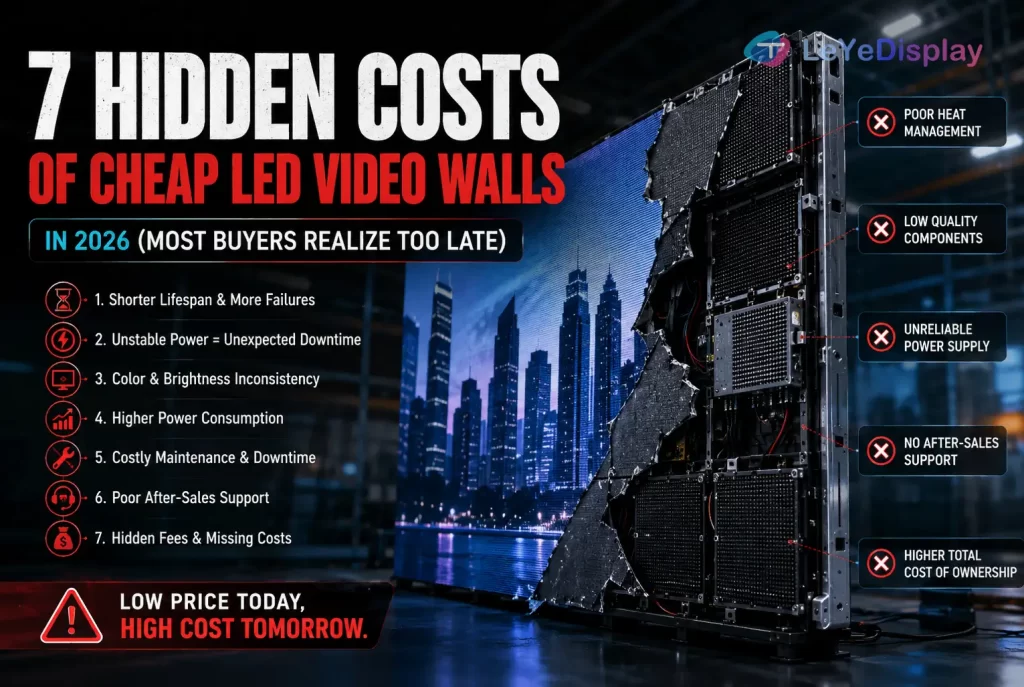
This is also why comparing LED suppliers purely by price per square meter can be misleading. Two quotations may appear similar while including different cabinets, processors, structures, spare parts, installation support or shipping scopes.
That comparison is a separate purchasing step, which we will cover in our guide on how to compare LED display quotations.
A Simple LED Display RFQ Template
If you are ready to contact manufacturers, you can copy this structure:
Project Type:
Corporate meeting room / retail / outdoor advertising / event / etc.Environment:
Indoor / OutdoorScreen Size:
Approx. ___ W × ___ HViewing Distance:
Closest ___ m / Typical ___ mContent:
Presentation / Video / Text / Live Camera / Dashboard / OtherInstallation:
Wall-mounted / Hanging / Structure / Rental / OtherMaintenance:
Front / Rear / Not sureProject Location:
City, CountryRequired Delivery:
Required delivery date or project deadline.
Available Information:
Photos / Drawings / Measurements / Existing EquipmentPlease Recommend:
Suitable pixel pitch, cabinet configuration, controller, installation requirements and complete quotation.
This gives the supplier enough context to start an engineering discussion rather than simply sending back a generic product price.
Final Takeaway
You do not need to become an LED engineer before requesting an LED display quotation.
Your job as the buyer is to describe the project clearly.
The manufacturer’s job is to translate those project conditions into a practical LED display configuration and commercial proposal.
So before sending an RFQ, remember:
Don’t just tell the manufacturer what screen you think you want. Tell them where it will be used, how it will be viewed, how it will be installed, what it needs to display, and when you need it.
The better the project information, the more useful your LED display quotation will be.