Fine Pitch LED Display Trends 2026 Are Changing the Buying Decision
Fine Pitch LED Display Trends 2026 are no longer simply about making pixels smaller.
The market is changing in several directions at the same time. COB is expanding beyond the ultra-fine-pitch segment, MIP is developing as another route toward MicroLED, sub-1mm products are gaining attention, and buyers are increasingly evaluating resolution, viewing distance and total system performance rather than pixel pitch alone.
Recent market data illustrates this shift. Omdia reported that global LED video display shipments increased 0.6% year over year in Q1 2026, while revenue declined 2.3%. More importantly for fine-pitch applications, shipments in the 0.60–0.99 mm category increased 11.6%, while the 1–1.99 mm segment experienced revenue pressure.
That makes the 2026 market more complicated than a simple move from P1.5 to P1.2 to P0.9.
For system integrators and professional LED display buyers, the real question is becoming:
Which pixel pitch and packaging technology actually make sense for the project?
This article looks at the major changes behind that decision.
1. Fine-Pitch LED Is Moving Into a New Stage
For years, the development of fine-pitch LED could be understood through a relatively simple trend: pixel pitch became smaller, pixel density increased and LED displays moved closer to the viewer.
That trend continues, but it no longer tells the complete story.
Today, a project in the P0.7–P1.5 range may involve COB, MIP or SMD depending on the required pitch, product architecture and application.
At the same time, buyers are asking more detailed questions about:
- screen resolution;
- viewing distance;
- black-level performance;
- color consistency;
- surface protection;
- operating temperature;
- power consumption;
- maintenance;
- and long-term reliability.
This is important because the industry is no longer competing only on how small the pixel pitch can become.
It is increasingly competing on how effectively a fine-pitch LED display performs as a complete visual system.
Omdia’s Q1 2026 market analysis similarly points to ultra-fine pixel pitch, COB/MIP miniaturization, high refresh rates, improved grayscale and power efficiency as important areas of development.
2. Sub-1mm LED Displays Are Gaining Momentum
One of the clearest Fine Pitch LED Display Trends 2026 is continued development below P1.0.
Omdia reported an 11.6% year-over-year increase in shipments for the 0.60–0.99 mm category in Q1 2026.
That does not mean every project is moving to P0.9 or P0.7.
It does show that sub-1mm LED is becoming increasingly relevant for applications where close viewing and high pixel density matter.
Typical examples include:
- control rooms;
- command centers;
- high-end boardrooms;
- broadcast environments;
- premium corporate spaces;
- and specialized visualization systems.
At these pitches, packaging technology becomes increasingly important.
Traditional SMD becomes more difficult to scale as individual packages become smaller and pixel density increases. This is one reason COB and MIP are receiving so much attention in the ultra-fine-pitch market.
But the shift should not be interpreted as a race in which the smallest number automatically wins.
A P0.7 screen used at an inappropriate viewing distance can simply add cost and pixel density that the project does not need.
3. COB Is Expanding Beyond the Ultra-Fine-Pitch Market
COB has been one of the most important developments in fine-pitch LED during recent years.
Instead of mounting individually packaged SMD LEDs onto the PCB, COB mounts LED chips directly onto the substrate before encapsulation.
For the end user, the manufacturing terminology is less important than the resulting characteristics.
COB can provide a smooth protected surface, strong resistance to physical contact and contamination, and a structure well suited to increasingly dense pixel layouts.
But one of the more interesting developments in 2026 is that COB is no longer discussed only in connection with P0.9 and below.
Industry research reported this year indicates that P1.2 remains an important COB shipment category in the near term, while P1.5-and-above COB is expected to gain importance as manufacturing processes mature and costs decline.
This changes the competitive landscape.
A buyer considering P1.5 may increasingly encounter both COB and SMD solutions rather than automatically treating COB as an ultra-premium option reserved for the smallest pitches.
COB Still Has Trade-Offs
That does not make COB the automatic answer.
Real project evaluation still needs to consider:
- black-level and surface consistency;
- color uniformity;
- module replacement;
- batch consistency;
- repair strategy;
- supplier process control;
- and cost.
Unlike conventional SMD, individual LEDs generally cannot be repaired on site in the same way once they are integrated into the COB surface.
For professional projects, therefore, COB should be evaluated on the quality of the complete product and the manufacturer’s process—not simply on the word COB in the specification.
4. MIP Is Becoming Another Important Fine-Pitch Route
MIP — Micro LED in Package — approaches miniaturization differently.
Instead of integrating many bare chips directly onto a large board in the same way as COB, very small LED chips can be packaged, tested and sorted before subsequent assembly.
This gives MIP an interesting position in the development toward ultra-fine-pitch and MicroLED displays.
ndustry research in 2026 increasingly points toward COB and MIP developing in parallel rather than following a simple winner-takes-all path.. Recent industry reporting describes both technologies across increasingly broad pitch ranges, while MIP receives particular attention toward ultra-fine pitches.
For buyers, however, COB vs MIP should not become another specification-sheet argument.
The useful questions are more practical:
Can the manufacturer achieve consistent black levels?
How consistent are modules from different production batches?
What happens when a module needs replacement?
How mature is the product platform?
What does the additional performance cost?
Packaging technology matters, but the final screen still has to work reliably after installation.
5. The Competitive Landscape Changes as Pixel Pitch Gets Smaller
The relationship between SMD, COB and MIP becomes easier to understand when pixel pitch is considered as a range rather than a single specification.
| Pixel Pitch | Technologies Buyers May Encounter | Typical Considerations |
|---|---|---|
| P1.8–P2.5 | SMD, increasing COB options | Cost, viewing distance, established product platforms |
| P1.2–P1.5 | SMD and COB increasingly overlap | Close viewing, protection, consistency, project budget |
| P0.9–P1.2 | COB becomes increasingly important; MIP options emerge | Pixel density, surface quality, reliability |
| P0.7–P0.9 | COB and MIP receive greater consideration | Ultra-fine pitch, consistency, manufacturing quality |
| Below P0.7 | COB/MIP become the primary technologies under consideration | Ultra-high pixel density, MicroLED development, specialized visualization |
The table is not intended as a technology ranking. It shows how the competitive landscape changes as pixel pitch becomes smaller.
In practice, the best choice still depends on the complete screen size, viewing distance, content, operating environment, maintenance requirements and budget.
This overlap is important because it prevents a common procurement mistake:
Packaging technology should not be selected independently from the project requirements.
6. 4K and 8K Are Changing How Buyers Think About LED Pixel Pitch
Pixel pitch and resolution are closely related, but they are not the same thing.
Pixel pitch tells us the physical distance between adjacent pixels.
Resolution tells us how many pixels exist across the complete display.
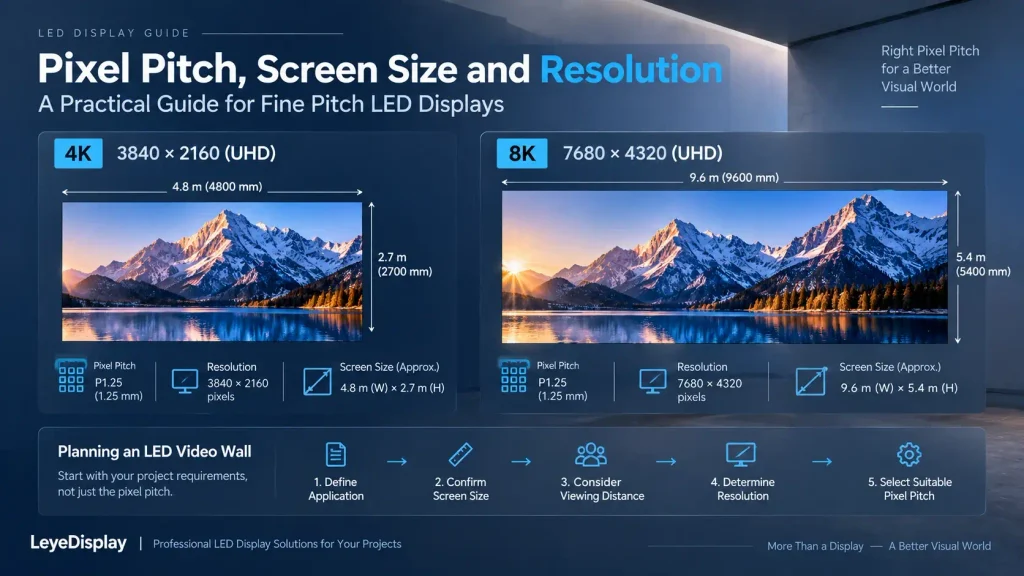
That means the same P1.25 product can create completely different resolutions depending on the physical size of the LED wall.
For example, a theoretical P1.25 display needs approximately:
3840 × 1.25 mm = 4800 mm
of active width to reach 3840 horizontal pixels.
For 2160 vertical pixels:
2160 × 1.25 mm = 2700 mm
So a P1.25 display with an active area of approximately 4.8 × 2.7 m can provide a theoretical 3840 × 2160 4K canvas, before practical cabinet/module configuration is considered.
This is why asking:
“What pixel pitch do I need for 4K?”
does not have a single answer.
A better planning process is:
Target resolution → available screen dimensions → viewing distance → suitable pixel pitch → module/cabinet configuration.
The same logic becomes even more important when planning 8K or custom ultra-wide canvases.
7. Fine Pitch LED Display Trends 2026: What They Mean for Buyers
The shift toward finer pixel pitches does not mean every LED display project should automatically move to P1.0 or below.
The more important change is that pixel pitch is becoming part of a larger system-level decision.
A few years ago, a project might begin with:
“We need a P1.5 LED display.”
Today, that is often not enough information.
A professional project should also consider:
- Viewing distance — How close will the nearest viewer be?
- Screen dimensions — What physical area is available?
- Target resolution — Full HD, 4K, 8K or a custom canvas?
- Content — Video, presentations, spreadsheets, dashboards or detailed data?
- Operating environment — Meeting room, control room, studio or commercial space?
- Maintenance — What access and replacement strategy is required?
- Budget — Does a smaller pitch create enough practical benefit to justify its cost?
Smaller Pixel Pitch Is Not Automatically Better
It is tempting to read pixel pitch as a simple performance ranking:
P0.9 > P1.2 > P1.5 > P1.8
That is not how a real project should be evaluated.
A smaller pixel pitch provides higher pixel density. But if the viewing distance is relatively long and the required resolution can already be achieved with a larger pitch, reducing pitch further may produce limited visible benefit.
The opposite is also true.
For close-viewing applications involving spreadsheets, engineering drawings, monitoring interfaces or detailed presentation content, higher pixel density can be genuinely useful.
Instead of asking:
What is the smallest pixel pitch we can afford?
ask:
What pixel pitch gives this project the right balance of viewing experience, resolution, reliability and cost?
8. Which Pixel Pitch Makes Sense for Different Applications?
There is no single best pixel pitch for every application.
The following ranges are useful as initial planning references, not fixed specifications.
| Application | Typical Range to Evaluate | Main Project Considerations |
|---|---|---|
| Boardrooms & Meeting Rooms | P0.9–P1.5 | Close viewing, presentations, spreadsheets, conferencing |
| Control Rooms | P0.7–P1.5 | Fine text, dashboards, continuous operation |
| Broadcast & Studios | P0.7–P1.5 | Camera performance, refresh rate, color consistency |
| Corporate Lobbies | P1.2–P2.5 | Viewing distance, visual impact, architecture |
| Retail & Showrooms | P1.2–P2.5 | Content quality, brightness, viewing distance |
| Auditoriums & Churches | P1.5–P2.5 | Large screens, mixed viewing distances, budget |
| Indoor Rental | P1.9–P3.9 | Durability, repeated installation, viewing distance |
| Outdoor Applications | P2.6 and above | Brightness, environment, viewing distance |
These ranges should not replace project calculations.
Meeting Rooms and Boardrooms
Meeting rooms are one of the clearest examples of where fine-pitch LED can provide a practical benefit.
Viewers may sit only a few meters from the screen, while the content often includes PowerPoint, Excel, documents and video conferencing.
P0.9–P1.5 can therefore be worth evaluating.
But if P1.25 or P1.5 already provides the required resolution and viewing experience, moving to P0.9 simply because it is finer may not be justified.
Control Rooms
Control-room operators often need to read small text and monitor detailed dashboards for extended periods.
Pixel density matters, but so do reliability, consistency and long-term operation.
This makes approximately P0.7–P1.5 an important range to evaluate, with the final choice determined by screen dimensions, operator distance and required canvas resolution.
Broadcast and Studios
Broadcast applications introduce another variable: the camera.
A display that looks excellent to the human eye does not necessarily perform the same way through a professional camera.
Refresh rate, grayscale, scan configuration, color reproduction and camera compatibility should therefore be evaluated alongside pixel pitch.
Corporate, Retail and Commercial Spaces
Corporate lobbies, retail spaces and showrooms usually offer longer viewing distances.
For many of these projects, P1.2–P2.5 provides a useful starting range.
In a large-format installation, increasing physical screen size can sometimes create more visual impact than spending the same budget on an unnecessarily fine pixel pitch.
Auditoriums and Churches
Large indoor venues have mixed viewing distances.
The nearest viewer may be much closer to the display than the majority of the audience, so pitch should not be selected only for the farthest seat.
P1.5–P2.5 can often balance screen size, image detail and project cost.
Rental and Outdoor Applications
Rental projects introduce priorities such as cabinet weight, fast installation, repeated assembly and physical durability.
Outdoor applications add brightness, weather protection, heat management and longer viewing distances.
This is why larger pixel pitches remain highly relevant even while the fine-pitch market continues to develop.
9. What Should LED Display Buyers Watch Next?
Three developments deserve particular attention beyond 2026.
COB Is Moving Into Broader Pixel-Pitch Ranges
COB is no longer restricted to the ultra-fine end of the market.
As manufacturing capacity expands and cost structures change, buyers are likely to encounter COB across more P1.2, P1.5 and larger-pitch projects. This is also why different COB platforms are emerging for different pixel-pitch and system-planning requirements.
That does not mean SMD disappears.
It means the overlap between available technologies becomes wider.
MIP Will Keep Pressure on the Ultra-Fine-Pitch Market
MIP provides another route toward very small pixels and MicroLED commercialization.
The technology remains especially relevant when projects move toward P0.9, P0.7 and below, although actual product maturity and supplier capability must still be evaluated.
Industry reporting around the 2026 COB/MIP market similarly describes MIP as being at an earlier growth stage than COB, rather than treating the two as interchangeable technologies.
Resolution Will Matter More Than Pitch Alone
As professional LED walls increasingly target 4K, 8K and custom high-resolution canvases, buyers will need to think beyond a single pitch number.
Instead of:
“We need P1.2.”
a more useful project brief is:
“We have a 5-meter-wide wall, the nearest viewer is approximately 3 meters away, and the system needs to display detailed 4K content.”
That gives the LED supplier or system integrator enough information to start designing the system rather than simply quoting a product.
10. Conclusion: Start With the Project, Not the Pixel Pitch
The most important Fine Pitch LED Display Trends 2026 point toward a market with more choices rather than one universal technology winner.
COB is expanding into broader fine-pitch applications. MIP is developing at the ultra-fine end. SMD remains relevant across established indoor, rental and outdoor applications. Meanwhile, sub-1mm products continue to advance.
For buyers, that makes project definition more important than ever. For a complete selection framework, see our LED Video Wall Buying Guide.
Viewing distance, screen dimensions, resolution, content, operating conditions, maintenance and budget should be established before deciding whether the project needs P1.5, P1.2, P0.9 or something even smaller.
A smaller pixel pitch can increase pixel density.
It does not automatically create a better project.
The industry may be moving toward smaller pixels, but successful LED display projects still start with the application—not the specification.
Frequently Asked Questions About Fine Pitch LED Displays
There is no single best pixel pitch. The appropriate choice depends on viewing distance, physical screen dimensions, target resolution, content and budget. Close-viewing professional applications often evaluate approximately P0.7–P1.5, while larger indoor spaces may achieve excellent results with larger pitches.
P1.2 provides higher pixel density than P1.5, but that does not automatically make it better.
If viewers are close to the screen or the required resolution must fit into a limited physical area, P1.2 may provide a meaningful advantage. If P1.5 already meets the viewing and resolution requirements, the additional cost of P1.2 may not create equivalent project value.
There is no fixed pixel pitch for 4K.
A 4K UHD canvas requires 3840 × 2160 pixels. At P1.25, the theoretical active dimensions are approximately 4.8 × 2.7 m because 3840 × 1.25 mm = 4800 mm and 2160 × 1.25 mm = 2700 mm.
Actual dimensions must also match the module and cabinet resolution of the selected LED system.
Not in every project.
COB can provide strong surface protection and is well suited to increasingly fine pixel pitches. SMD remains a mature technology with established manufacturing, maintenance and cost characteristics.
The correct choice depends on pitch, viewing requirements, reliability, service strategy and project budget.
COB mounts multiple LED chips directly onto a substrate before encapsulation.
MIP packages very small LED chips before subsequent assembly, allowing testing and sorting at the package stage.
Both can support very fine pixel pitches, but their manufacturing processes, scalability, maintenance characteristics and cost structures differ.
No.
Smaller pitch increases pixel density and can improve detail at close viewing distances. Once the required resolution and viewing experience have already been achieved, however, reducing pixel pitch further can produce diminishing practical benefits while increasing project cost.
COB is increasingly competing with SMD in fine-pitch indoor applications, but complete replacement is not the most useful way to view the market.
SMD continues to serve many indoor, rental and outdoor applications. Buyers are more likely to encounter a period of overlapping technology choices, particularly around mainstream fine-pitch ranges.
Planning a Fine-Pitch LED Project?
Pixel pitch is only one part of the specification.
Share your screen dimensions, viewing distance, application and target resolution with our team. We can help evaluate an appropriate LED display configuration based on the actual project requirements.