The China LED supply chain price surge 2026 is already affecting procurement decisions for many overseas LED projects.
Across China’s LED supply chain, suppliers of LED chips, driver ICs, PCB boards, power supplies, packaging materials, and structural components are raising prices at an unusually rapid pace. In many cases, quotations are only valid for 24 hours — or even less.
For overseas buyers, system integrators, rental companies, and project contractors, this situation creates a serious challenge:
How can procurement teams control project cost while maintaining product quality and delivery stability?
This article analyzes the real reasons behind the China LED supply chain price surge 2026, how it impacts LED display projects, and what buyers should do right now to reduce procurement risk.
Why the China LED Supply Chain Is Rising So Fast in 2026
The current market situation is not caused by a single factor.
Instead, multiple upstream pressures are happening simultaneously across the electronics and semiconductor ecosystem.
According to recent industry reports, many Chinese LED suppliers have already increased prices by 5%–15% in 2026.
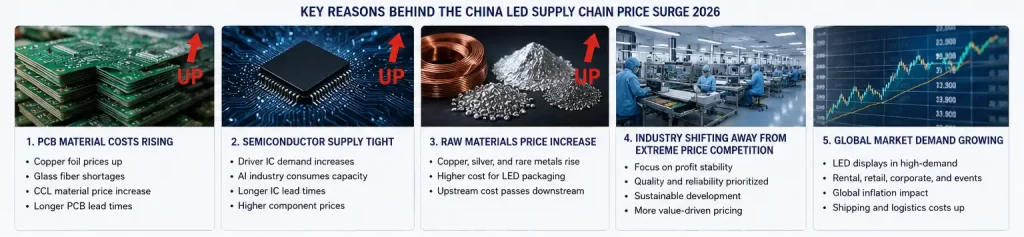
1. PCB Material Costs Are Increasing Rapidly
PCB boards are one of the most important cost components in LED displays.
However, in 2026:
- Copper foil prices continue rising
- Glass fiber shortages remain unstable
- CCL material prices are increasing
- PCB lead times are becoming longer
Several reports indicate PCB prices have risen significantly due to supply chain pressure and AI infrastructure demand.
For LED display manufacturers, this directly increases module and cabinet production cost.
2. Driver IC and Semiconductor Supply Remain Tight
Many LED displays still rely on mature-node semiconductor production.
At the same time, AI infrastructure growth is consuming large amounts of semiconductor capacity globally.
This has created:
- Longer IC procurement cycles
- Reduced spot inventory
- Higher driver IC pricing
- More unstable quotation validity periods
For fine-pitch LED displays, driver IC cost increases are especially visible.
3. LED Packaging Suppliers Are Facing Raw Material Pressure
LED packaging depends heavily on:
- Silver paste
- Copper
- Bonding wire materials
- Rare metals
Industry analysis shows that these materials account for a large percentage of LED packaging cost.
As commodity prices continue rising, LED packaging suppliers are rapidly transferring cost pressure downstream.
4. The Entire Industry Is Moving Away From Extreme Price Competition
For several years, China’s LED industry operated under extremely aggressive price competition.
However, many manufacturers are now prioritizing:
- Profit stability
- Quality control
- Sustainable operation
- Supply chain security
Several industry observers believe the market is shifting toward a more value-driven pricing structure rather than unsustainable low-price competition.
This means buyers should no longer expect 2023–2024 pricing levels to remain available.
Procurement Alert: Navigating the 2026 China LED Price Surge?
With raw materials and chip supply chains tightening, LeYeDisplay is actively helping global partners secure stable pricing. If you are planning an upcoming video wall project and want to bypass middleman markups, we can help optimize your Bill of Materials (BOM).
How the China LED Supply Chain Price Surge 2026 Is Affecting Global Buyers
The current market environment creates several major risks for procurement teams.
Quotation Validity Is Becoming Extremely Short
Many suppliers now provide quotations valid for only:
- 24 hours
- 48 hours
- Same-day confirmation only
This is mainly because upstream component prices are changing too quickly.
For overseas projects with long internal approval processes, this creates budgeting difficulty.
Low-Cost Suppliers May Become High-Risk Suppliers
When raw material prices rise rapidly, extremely low quotations can become dangerous.
Some factories may attempt to reduce cost by:
- Using lower-grade LEDs
- Mixing LED bins
- Downgrading driver ICs
- Reducing PCB thickness
- Using unstable power supplies
In large LED projects, these compromises often lead to:
- Brightness inconsistency
- Color shift
- Flicker problems
- Shortened lifespan
- Higher maintenance cost
These quality compromises are among the most common cheap LED wall problems buyers encounter after installation. While the initial quotation may look attractive, hidden reliability issues often create significantly higher ownership costs over time.
Delivery Delays Are Becoming More Common
As upstream materials tighten, lead times become less predictable.
Some suppliers are now prioritizing:
- High-margin orders
- Long-term customers
- Large-volume projects
Buyers relying entirely on spot procurement may experience longer delivery cycles in 2026.
How Buyers Can Control LED Display Procurement Costs in 2026

Although prices are rising, buyers still have several effective strategies to reduce risk.
1. Lock Specifications Earlier
The longer buyers delay specification confirmation, the greater the pricing uncertainty becomes.
Important specifications to finalize early include:
- Pixel pitch
- Brightness
- Refresh rate
- Cabinet material
- Installation structure
Many pricing issues can be avoided when buyers understand how different specifications influence overall project cost. Early planning helps prevent unnecessary upgrades and reduces budget uncertainty.
👉 Read our guide on how to choose LED video wall pixel pitch.
2. Avoid Over-Specification
One of the most common procurement mistakes is purchasing specifications that exceed actual project requirements.
Examples include:
- Using ultra-fine pitch unnecessarily
- Choosing excessive brightness
- Selecting 7680Hz when 3840Hz is sufficient
- Over-designing cabinet structures
👉 Learn more in is 3840Hz refresh rate enough for LED video walls.
Many buyers assume higher specifications automatically deliver better results, but proper specification matching often provides better ROI than simply selecting premium numbers across the board.
Proper specification control can significantly reduce total project cost.
3. Work With Engineering-Focused Suppliers
In unstable markets, supplier capability becomes more important than short-term pricing.
Professional engineering-based suppliers typically provide:
- More stable component sourcing
- Better inventory planning
- Technical optimization
- Long-term spare part support
This often reduces total lifecycle cost even if initial pricing is slightly higher.
Experienced buyers increasingly evaluate suppliers based on engineering capability, long-term support, and system reliability rather than quotation alone.
4. Consider Strategic Procurement Timing
Many experienced buyers are now:
- Confirming projects earlier
- Locking deposits sooner
- Reserving production capacity in advance
Because in the current market, waiting may not reduce pricing.
In some cases, delayed purchasing actually increases total project cost.
Why Shenzhen Remains the Center of the Global LED Supply Chain
Despite current pricing pressure, China — especially Shenzhen — continues to dominate global LED display manufacturing.
The region benefits from:
- Dense component ecosystems
- Driver IC supply networks
- PCB manufacturing capacity
- Engineering talent
- Export infrastructure
Industry sourcing reports continue to identify Shenzhen as the world’s most concentrated LED display manufacturing hub.
This concentration still provides major advantages in:
- Product customization
- Production speed
- Technical integration
- After-sales support
As the China LED supply chain price surge 2026 continues, strategic procurement decisions will become increasingly important.
The China LED supply chain price surge 2026 is not simply a short-term fluctuation.
Many of the same supply chain pressures are also influencing LED video wall pricing globally, making it increasingly important for buyers to evaluate both upfront cost and long-term project value.
It reflects deeper structural changes happening across:
- Semiconductor manufacturing
- PCB materials
- Commodity pricing
- Global supply chains
- AI-driven electronics demand
For buyers, the key priority in 2026 is no longer finding the absolute cheapest quotation.
Instead, successful procurement will depend on:
- Supplier stability
- Accurate specification planning
- Risk control
- Long-term reliability
- Strategic purchasing timing
Buyers who manage these factors correctly can still control procurement cost while protecting project quality and delivery schedules.
Planning an LED Display Project in 2026?
Many buyers are now seeking professional guidance to navigate the China LED supply chain price surge 2026 effectively.
LeyeDisplay helps global buyers optimize LED display procurement during rapidly changing market conditions.
Our engineering team can help you:
- ✔ Optimize specifications
- ✔ Reduce unnecessary cost
- ✔ Improve procurement stability
- ✔ Recommend suitable configurations
- ✔ Control long-term maintenance risk
Contact our team for a customized proposal and technical consultation. Our engineering team will respond within 24 hours with a tailored LED solution and project recommendations.