Selecting the right LED driver IC is one of the most overlooked—but most critical—decisions in LED video wall engineering. From image quality and grayscale performance to power efficiency and long-term reliability, the LED driver IC directly defines how an LED display performs in real-world installations.
In 2025, as LED video wall applications expand across control rooms, corporate spaces, retail environments, and broadcast studios, manufacturers and integrators can no longer treat the LED driver IC as a background component. Instead, it must be evaluated as a core system-level choice.
Drawing from factory engineering experience and large-scale deployment feedback, this guide explains how to choose the right LED driver IC, how it affects LED products, and how solution providers like LeyeDisplay, acting as an engineering solution partner, evaluate IC selection to optimize performance and ROI.
Why the LED Driver IC Matters More Than Ever in 2025
In modern LED video wall systems, the LED driver IC functions as the bridge between digital signal processing and visible image output. It controls:
- Grayscale depth and low-gray performance
- Refresh rate and motion smoothness
- Power consumption and heat generation
- Brightness consistency and color accuracy
As pixel pitches move below P1.2 and COB/MiniLED packaging becomes mainstream, the tolerance window for driver IC performance narrows significantly. A poorly matched LED driver IC can negate the benefits of premium LEDs, advanced calibration, or high-end controllers.
From an engineering standpoint, LED video wall failures related to flicker, uneven brightness, or excessive power draw often trace back to driver IC limitations, not LED chips themselves.
Key Performance Areas Impacted by LED Driver IC Selection
Grayscale Depth and Low-Gray Uniformity
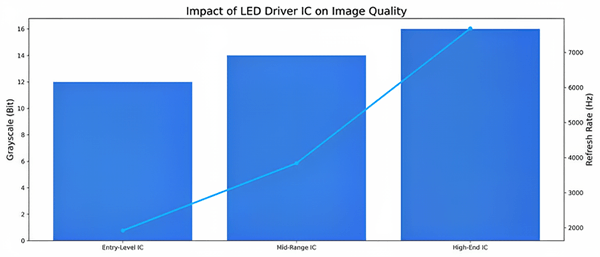
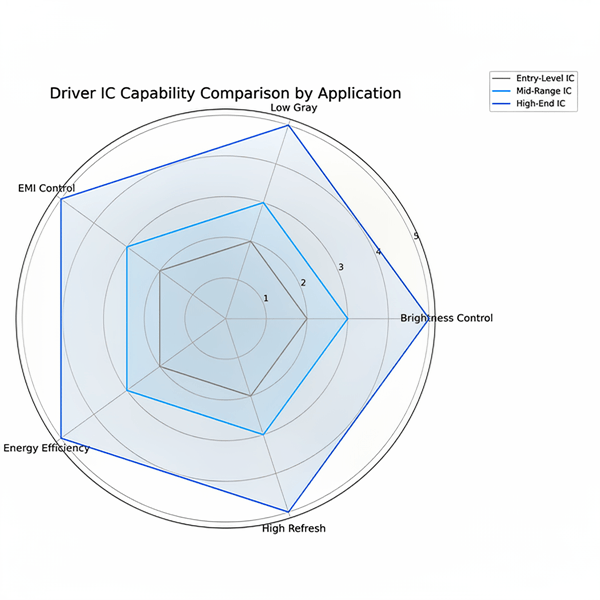
High-end LED video walls in 2025 increasingly require 16-bit grayscale or higher. The LED driver IC determines whether subtle gradients remain smooth or break into banding—especially in dark scenes.
- Entry-level ICs: typically 12-bit
- Mid-range ICs: 14-bit
- High-end ICs: true 16-bit grayscale
In applications like broadcast studios or control rooms, low-gray stability is non-negotiable. This is why engineering-focused solution providers such as LeyeDisplay prioritize high-bit-depth driver ICs when designing fine-pitch indoor LED systems.
Refresh Rate and Camera Compatibility
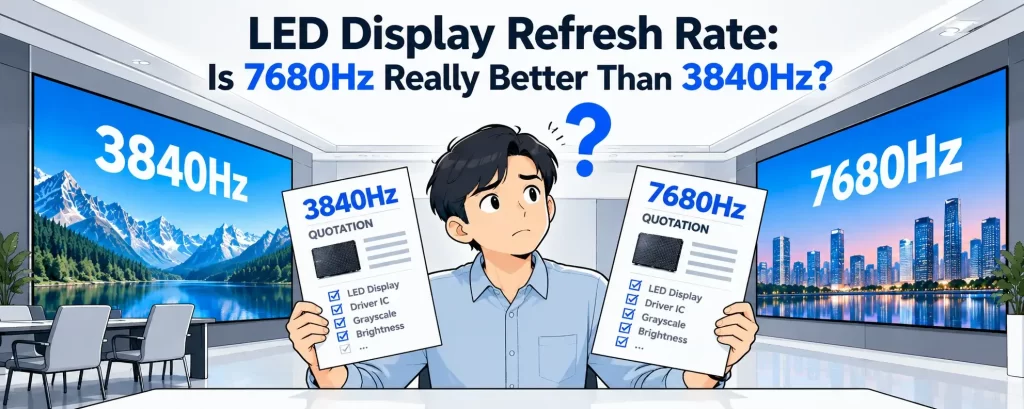
The LED driver IC also defines maximum refresh rate, which directly affects flicker-free performance on camera. (By: Zora.Zhang)
- 1920 Hz: basic indoor applications
- 3840 Hz: professional conference and retail
- 7680 Hz+: broadcast, XR, and virtual production
Even with a powerful video processor, a weak LED driver IC creates visible scan lines or rolling artifacts under camera capture. For projects involving hybrid meetings or media production, driver IC capability must be validated at the system level.
Power Consumption and Thermal Control
Power efficiency is no longer just a cost issue—it impacts system lifespan.
Advanced LED driver ICs using common-cathode architecture and intelligent current control can reduce power consumption by 20–35% per square meter. Lower heat output improves:
- LED lifespan
- Color stability over time
- Cabinet structural reliability
From an engineering solution perspective, LeyeDisplay evaluates driver IC power curves alongside cabinet airflow and PSU redundancy to ensure stable 24/7 operation in control centers and enterprise deployments.
Driver IC vs LED Product Quality: A Factory-Level Perspective
Many buyers compare LED video walls based on pixel pitch, brightness, or LED brand. However, factory engineers know that two displays using the same LED chips can perform very differently due to LED driver IC selection.
| Driver IC Level | Visual Quality | Power Efficiency | Typical Use Case |
|---|---|---|---|
| Entry-Level IC | Basic | Low | Cost-driven signage |
| Mid-Range IC | Stable | Medium | Retail & meeting rooms |
| High-End IC | Broadcast-grade | High | Control rooms, XR, studios |
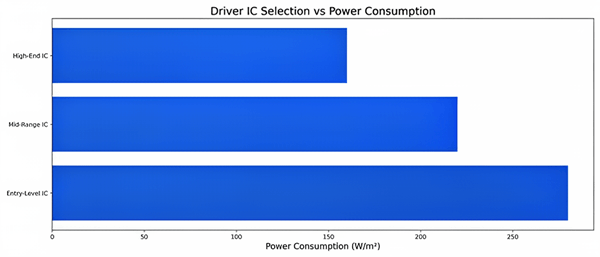
This is why engineering-oriented manufacturers do not treat the LED driver IC as a cost-cutting component. Instead, it is matched to application risk level, operating hours, and visual tolerance.
How to Choose the Right LED Driver IC by Application
Conference Rooms & Corporate Spaces
- Recommended IC: High-refresh, 16-bit grayscale
- Priority: Flicker-free video calls, low eye fatigue
- Engineering note: Avoid over-brightness; focus on stability
Control Rooms & Command Centers
- Recommended IC: Redundant-capable, low-gray optimized
- Priority: 24/7 reliability, data clarity
- Engineering note: Driver IC thermal behavior matters more than peak specs
Retail & Commercial Signage
- Recommended IC: Balanced performance-to-cost
- Priority: Color consistency, moderate refresh
- Engineering note: Match IC to content type, not just pixel pitch
Broadcast, XR & Virtual Production
- Recommended IC: Ultra-high refresh (≥7680 Hz)
- Priority: Camera synchronization, color accuracy
- Engineering note: Driver IC must be tested with real cameras
In project-based workflows, LeyeDisplay acts as an engineering solution provider by aligning LED driver IC selection with the client’s actual usage scenario—not generic datasheets.
Common Driver IC Mistakes Buyers Should Avoid
- Choosing ICs based only on price
- Ignoring refresh rate under camera conditions
- Overlooking low-gray performance
- Failing to consider long-term power consumption
- Treating all LED driver ICs as interchangeable
These mistakes often lead to higher total cost of ownership—even if the initial LED video wall price looks attractive.
Engineering Takeaway: Driver IC Selection Defines the System
From a factory engineer’s viewpoint, the LED driver IC is not a secondary component—it is a system-defining decision. Image quality, efficiency, and reliability all converge at this level.
For buyers and integrators seeking long-term performance rather than short-term savings, working with an engineering-focused solution partner like LeyeDisplay ensures that driver IC selection is aligned with real-world operating conditions, not marketing specs.
As LED video walls become more application-specific in 2025, understanding how to choose the right LED driver IC becomes a competitive advantage. Whether you are designing a control room, corporate display, or immersive visual environment, the driver IC will ultimately decide whether your LED product performs as expected—or falls short.
Need an engineering-level evaluation for your next LED project?
Contact LeyeDisplay for a driver-IC-matched LED video wall solution tailored to your application.