LED VIDEO WALL
BUYING GUIDE
How to Choose the Right LED Display for Your Project
What You'll Learn In This Guide
Why Choosing the Right LED Video Wall Is More Complicated Than It Looks
Many LED video walls look similar on paper.
The same pixel pitch, brightness, and cabinet size can produce dramatically different results in real-world projects.
That’s because long-term performance depends on far more than technical specifications alone.
Factors such as thermal management, power supply quality, energy efficiency, maintenance requirements, and supplier support often have a greater impact on project success than buyers initially expect.
This guide brings together the most important considerations for choosing an LED video wall—from pricing and pixel pitch to refresh rate, reliability, and supplier evaluation.
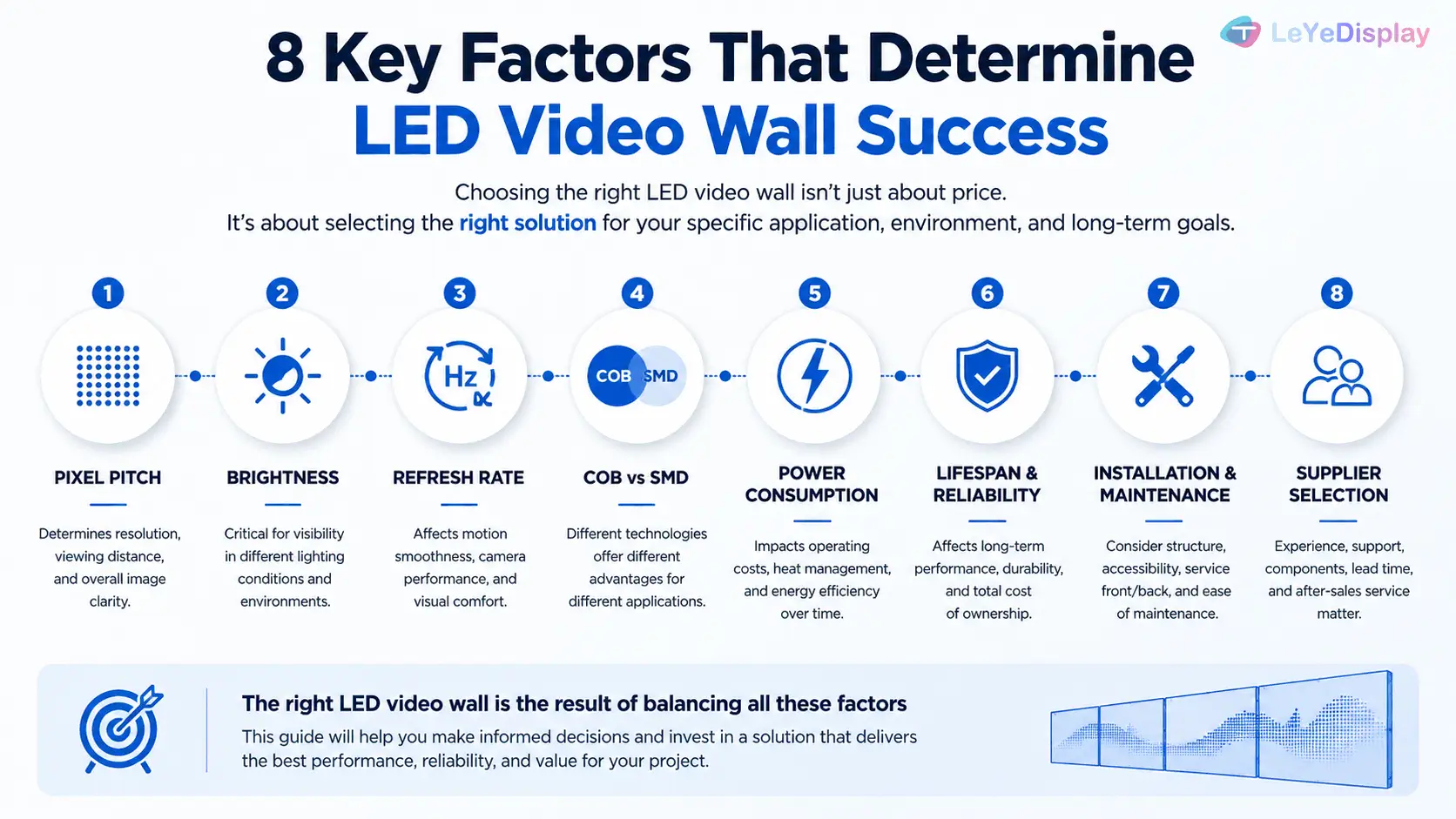
What Is an LED Video Wall?
An LED video wall is a large display system made up of multiple LED modules that work together to create a single seamless image.
Unlike traditional LCD video walls, LED displays do not have visible bezels between panels. This allows content to be presented as one continuous screen, making LED technology the preferred choice for applications where image quality, scale, and visibility are important.
Today, LED video walls are widely used in:
- Корпоративные конференц-залы
- Retail stores and shopping malls
- Control rooms and command centers
- Студии вещания
- Rental and live events
- Outdoor advertising displays
One of the biggest advantages of LED technology is flexibility. Buyers can choose different pixel pitches, brightness levels, cabinet designs, and display technologies based on their project requirements.
However, selecting the right LED video wall is not simply about choosing the highest specification. Factors such as viewing distance, application type, operating environment, and budget all play an important role in determining the most suitable solution.
Before comparing prices or technologies, the first step is understanding which pixel pitch is appropriate for your project.
Common LED Video Wall Applications
Common LED Video Wall Applications
LED video walls are used across a wide range of industries and environments.
The best display configuration often depends on viewing distance, content type, operating hours, and installation conditions.
The following applications represent some of the most common use cases in today’s LED display market.
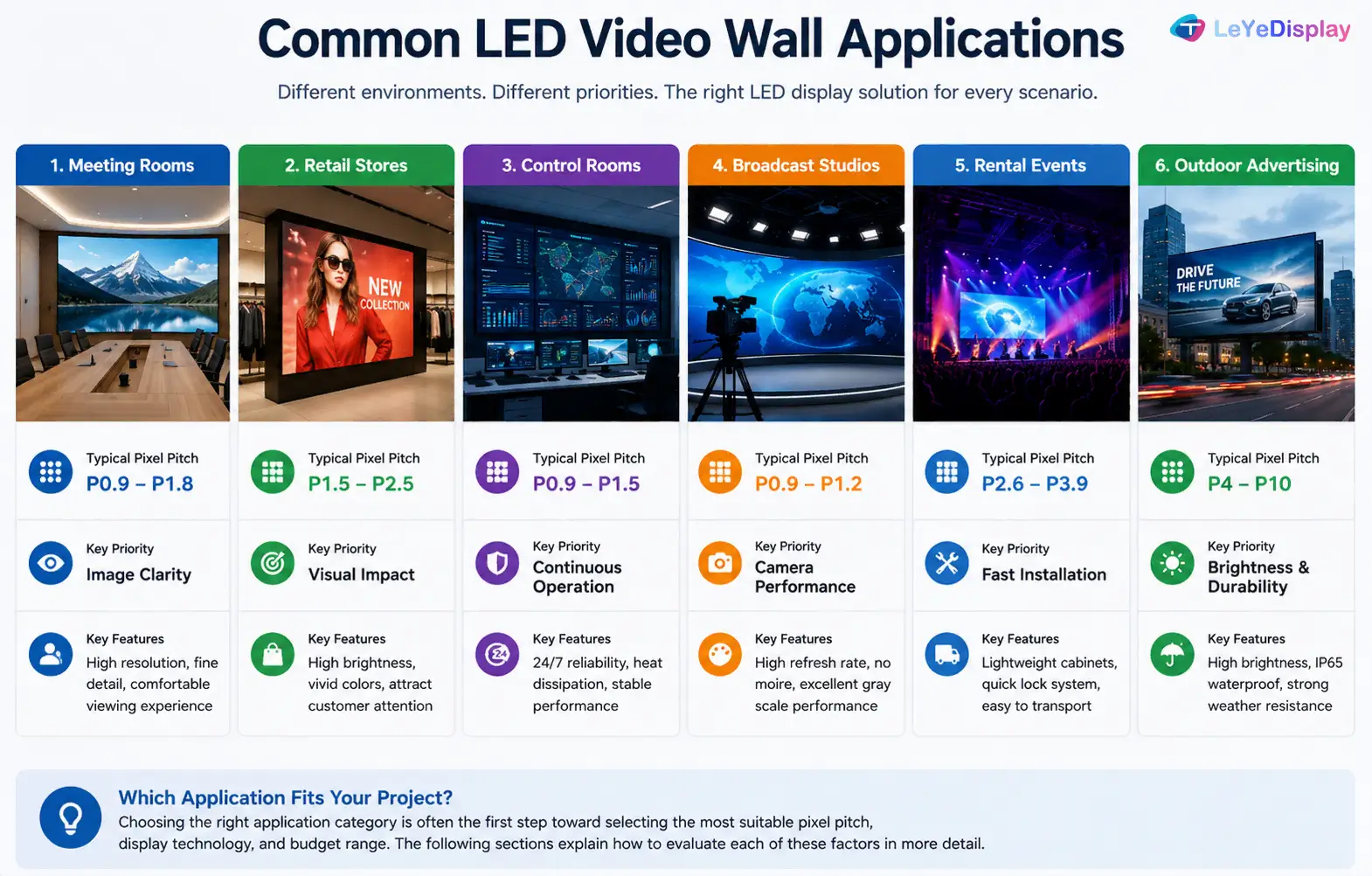
| Приложение | Typical Pixel Pitch | Key Priority |
|---|---|---|
| Meeting Rooms | P0.9 - P1.8 | Image Clarity |
| Розничные магазины | P1.5 - P2.5 | Visual Impact |
| Комнаты управления | P0.9 – P1.5 | Continuous Operation |
| Студии вещания | P0.9 - P1.2 | Camera Performance |
| Rental Events | P2.6 - P3.9 | Fast Installation |
| Наружная реклама | P4 – P10 | Brightness & Durability |
Which Application Fits Your Project?
Choosing the right application category is often the first step toward selecting the most suitable pixel pitch, display technology, and budget range.
The following sections explain how to evaluate each of these factors in more detail.
How to Choose the Right Pixel Pitch
What Is Pixel Pitch?
Pixel pitch refers to the distance between two adjacent LED pixels, measured in millimeters (mm).
In simple terms, the smaller the pixel pitch, the higher the resolution and the closer viewers can stand to the screen without seeing individual pixels.
Choosing the right pixel pitch is one of the most important decisions in any LED video wall project because it directly affects:
- Image clarity
- Расстояние просмотра
- Project cost
- Overall user experience
Many buyers assume that a smaller pixel pitch is always better. In reality, the best choice depends on how the screen will be used and how far viewers will typically stand from it.
| Расстояние просмотра | Рекомендуемый шаг пикселей |
|---|---|
| 1–2 meters | P0.9 - P1.2 |
| 2–4 meters | P1.5 - P2.5 |
| 4–8 meters | P2.5 – P4 |
| 8–15 meters | P4 – P6 |
| 15 meters+ | P6 – P10 |
As a general rule, the closer the audience is to the screen, the smaller the pixel pitch should be.
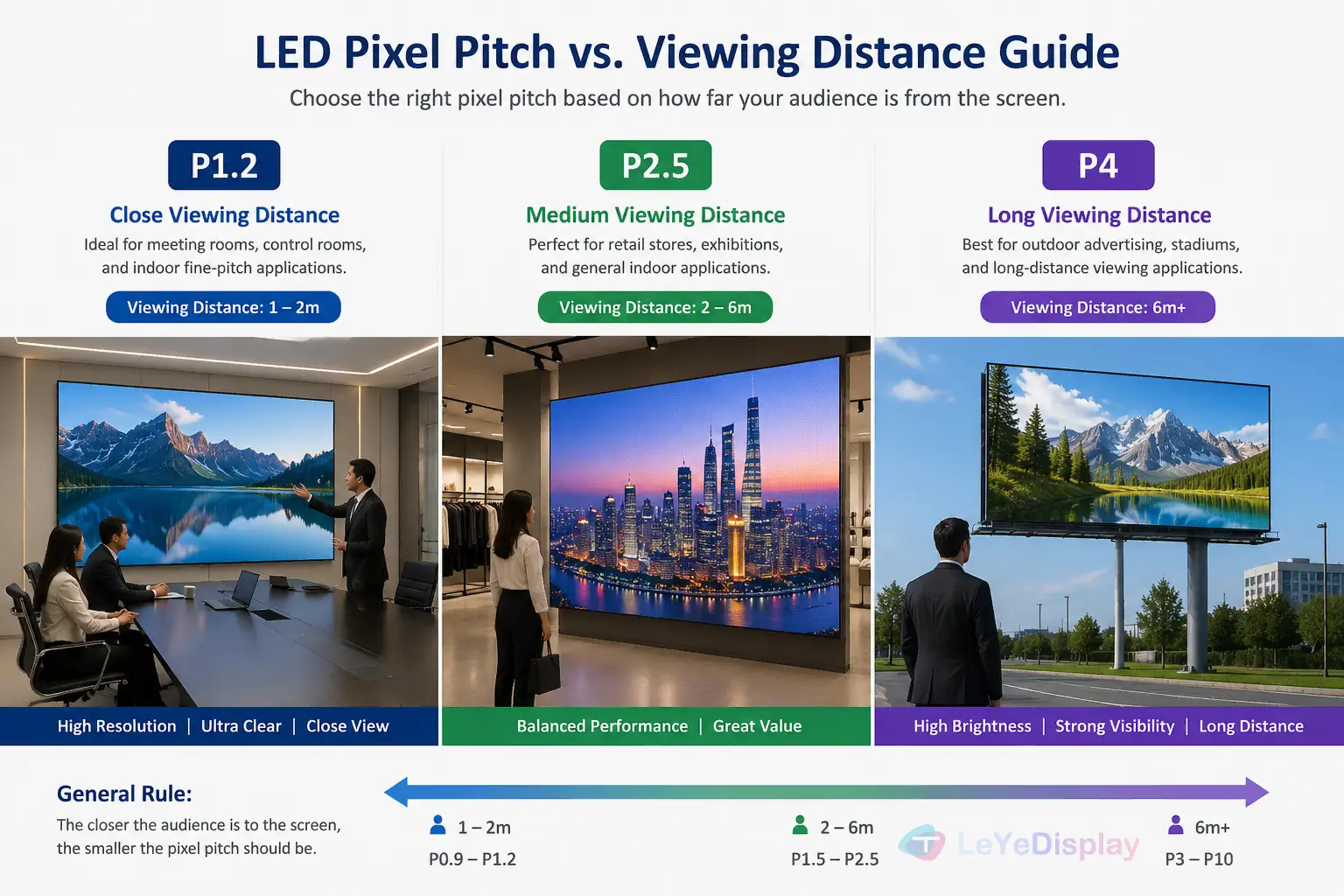
Typical Pixel Pitch Recommendations by Application
| Приложение | Рекомендуемый шаг пикселей | Typical Viewing Distance | Примечания |
|---|---|---|---|
| Meeting Rooms | P0.9 – P1.5 | 1–3m | Ideal for presentations and close viewing |
| Retail Displays | P1.5 - P2.5 | 2–5m | Good balance between image quality and budget |
| Комнаты управления | P0.9 - P1.2 | 1–2m | Suitable for detailed monitoring applications |
| Rental LED Screens | P2.6 - P3.9 | 4–10m | Designed for temporary events and stage applications |
| Наружная реклама | P4 – P10 | 8m+ | Optimized for long-distance visibility |
Common Pixel Pitch Mistakes
Many buyers either over-specify or under-specify their LED projects.
Common examples include:
❌ Choosing P0.9 for viewers standing 10 meters away
❌ Selecting P4 for a conference room where viewers sit only 2 meters from the screen
❌ Prioritizing resolution while ignoring budget and actual viewing conditions
The goal is not to choose the smallest pixel pitch available, but the most suitable pixel pitch for your application.
How Pixel Pitch Affects Price
Pixel pitch is often the single biggest factor affecting LED video wall cost.
As pixel pitch decreases, manufacturing complexity increases, which significantly impacts pricing.
👉 Read our detailed guide: LED Video Wall Price 2026
Once the appropriate pixel pitch has been determined, the next step is understanding how different technical specifications and component choices affect project pricing.
LED Video Wall Price Guide
Why LED Video Wall Prices Vary So Much
One of the most common questions buyers ask is:
“Why do two LED video walls with similar specifications have completely different prices?”
The answer is that LED display pricing is influenced by much more than pixel pitch alone.
Factors such as LED packaging technology, driver IC quality, cabinet design, power systems, and supplier support all contribute to the final project cost.
As a result, two screens that look similar on paper can perform very differently in real-world applications.
Typical LED Video Wall Price Range (2026)
| Приложение | Шаг пикселя | Typical Price Range (USD/m²) |
|---|---|---|
| Конференц-залы | P0.9 - P1.2 | $2,000 - $4,000 |
| Retail Displays | P1.5 - P2.5 | $1,200 - $2,500 |
| Комнаты управления | P1.2 - P1.5 | $2,500 - $4,500 |
| Rental LED Screens | P2.6 - P3.9 | $800 - $1,800 |
| Outdoor LED Displays | P4 – P10 | $600 - $2,000 |
These figures are intended as reference ranges only. Actual project pricing depends on screen size, configuration, installation requirements, and component selection.
Шаг пикселя
Smaller pixel pitches require more LEDs per square meter, increasing manufacturing complexity and cost.
In most projects, pixel pitch remains the single largest factor affecting total display price.
LED Packaging Technology
COB, SMD, and emerging MIP technologies all have different production costs and performance characteristics.
Higher-end packaging technologies often provide better durability and image quality, but usually come at a higher price.
Component Quality
Driver ICs, LEDs, power supplies, and PCB materials have a significant impact on both cost and long-term reliability.
Lower-priced products often achieve cost savings by using less expensive components.
Project Requirements
Installation structures, processing systems, spare parts, shipping, and technical support can all influence final project cost.
Many buyers underestimate these factors during the quotation stage.
Common Pricing Mistake
The lowest quotation is not always the lowest-cost solution.
In many projects, maintenance expenses, downtime, power consumption, and replacement costs can exceed the initial savings achieved through a lower purchase price.
Evaluating total cost of ownership often provides a more accurate picture of long-term value.
Want a Detailed Cost Breakdown?
This section provides a general overview of LED display pricing.
For a detailed analysis of cost structure, hidden expenses, and real-world pricing examples, read our complete guide:
Price is only one part of the decision-making process.
Many buyers also need to understand the differences between COB and SMD technologies before selecting the most suitable LED solution.
COB vs SMD: Which Technology Is Right for Your Project?
Understanding COB and SMD Technology
When comparing LED video walls, one of the most important technology decisions is choosing between COB (Chip-on-Board) and SMD (Surface-Mounted Device).
Both technologies are widely used in commercial LED displays, but they are designed for different priorities.
SMD remains the most common solution in the global LED display market due to its cost efficiency and versatility.
COB, on the other hand, is gaining popularity in premium indoor applications because of its improved durability, contrast performance, and protection against physical damage.
Understanding the strengths and limitations of each technology can help buyers select the most appropriate solution for their project requirements and budget.
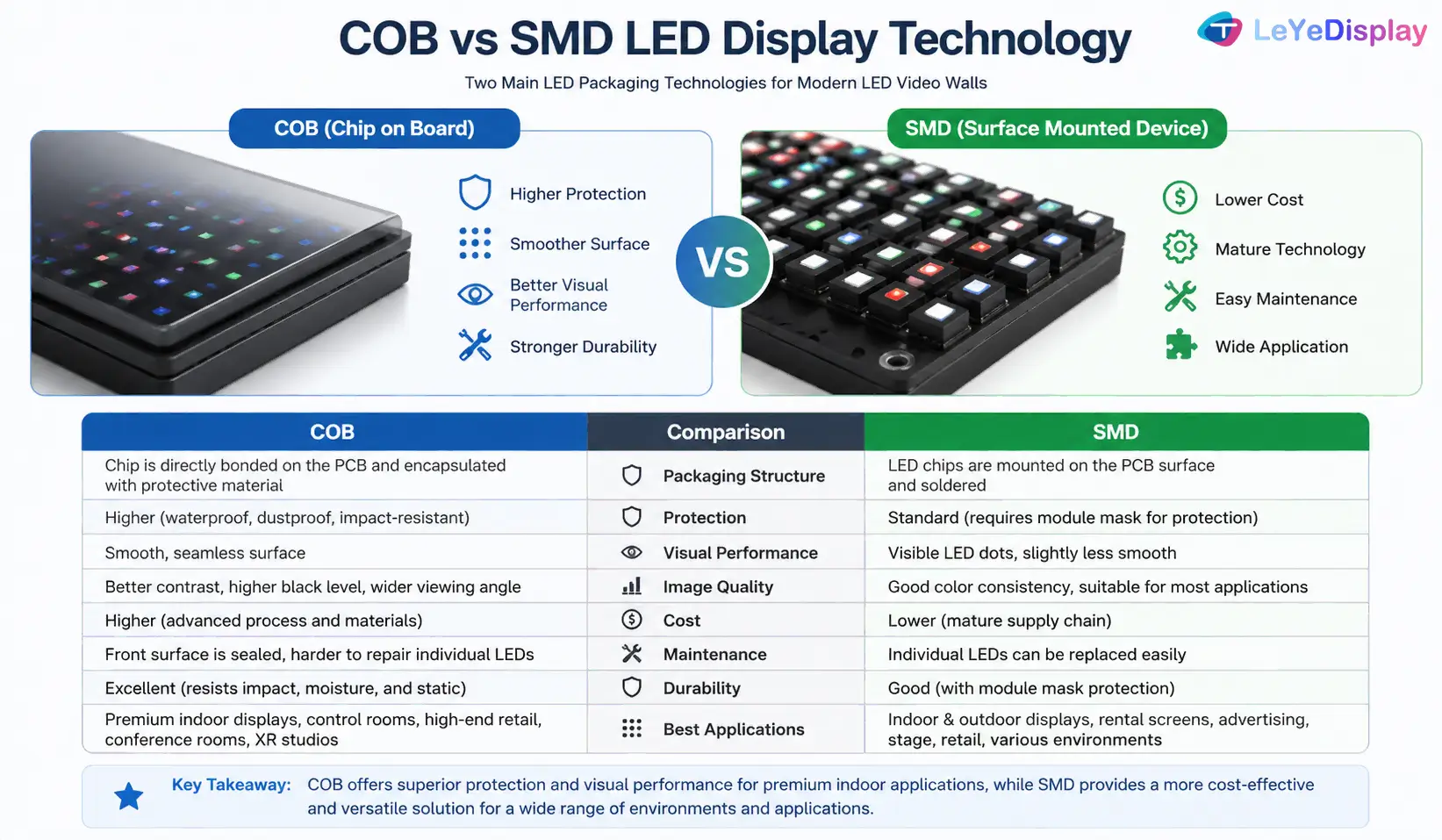
COB vs SMD Comparison
| Фактор | COB LED | SMD СВЕТОДИОД |
|---|---|---|
| Долговечность | Превосходно | Хорошо |
| Surface Protection | Высокий | Умеренный |
| Коэффициент контрастности | Выше | Standard |
| Black Uniformity | Better | Хорошо |
| Техническое обслуживание | Нижний | Выше |
| Initial Cost | Выше | Нижний |
| Market Adoption | Growing Rapidly | Widely Established |
| Лучший пример использования | Premium Indoor Projects | General Commercial Applications |
When to Choose COB
COB technology is often preferred for:
- Executive meeting rooms
- Студии вещания
- Control centers
- Luxury retail environments
- High-end corporate installations
These projects typically prioritize image quality, durability, and long-term reliability over the lowest initial purchase price.
When to Choose SMD
SMD remains the preferred option for:
- Аренда светодиодных дисплеев
- Вывески для розничной торговли
- Exhibition booths
- Standard conference rooms
- Outdoor LED projects
For many commercial applications, SMD continues to offer an excellent balance between performance and cost.
Buyer Tip
Many buyers assume COB automatically means “better.”
In reality, the best technology depends on your application, viewing environment, maintenance requirements, and budget.
For many projects, a high-quality SMD display may provide a better return on investment than a premium COB solution.
Learn More About COB vs SMD
This section provides a simplified overview.
For a deeper analysis of image quality, durability, maintenance, cost differences, and future technology trends, read:
Beyond display technology, another specification that often causes confusion among buyers is refresh rate.
Many projects now advertise 3840Hz, 7680Hz, or even higher values—but what do these numbers actually mean in real-world applications?
Need Help Choosing the Right LED Video Wall?
Choosing the wrong pixel pitch, brightness, or display technology can significantly impact project performance and long-term costs.
Our engineering team can help you evaluate the right solution based on your application, viewing distance, budget, and installation environment.
Understanding Refresh Rate: Is 3840Hz Enough?
What Is Refresh Rate?
Refresh rate refers to how many times per second an LED display updates the image being shown.
In today’s LED market, common refresh rate specifications include:
- 1920 Гц
- 3840 Гц
- 7680 Гц
- 15360Hz
Higher refresh rates generally help improve image stability, reduce flicker, and deliver better camera performance.
However, a higher number does not automatically mean a better choice for every project.
For many commercial installations, 3840Hz is already sufficient.
Recommended Refresh Rate by Application
| Приложение | Рекомендуемая частота обновления | Примечания |
|---|---|---|
| Meeting Rooms | ≥1920 Гц | Suitable for presentations and daily use |
| Retail Displays | ≥1920 Гц | Provides smooth playback for commercial content |
| Corporate Video Recording | ≥3840 Гц | Better camera performance |
| Студии вещания | ≥7680 Гц | Helps reduce flicker and camera artifacts |
| XR / Virtual Production | ≥7680 Гц | Preferred for professional production environments |
| Slow-Motion Filming | ≥15360 Гц | Best for advanced filming applications |
The ideal refresh rate depends not only on the display itself, but also on camera settings, content type, and application requirements.
Is 3840Hz Enough?
For most commercial LED video wall projects, the answer is yes.
3840Hz is generally sufficient for:
- Корпоративные конференц-залы
- Витрины для розничной торговли
- Hotels and hospitality venues
- Комнаты управления
- Standard video production
Many buyers mistakenly assume that higher refresh rates automatically deliver better results. In reality, refresh rate should be evaluated together with image quality, gray scale performance, and overall system design.
Common Refresh Rate Misconception
Refresh rate is only one part of display performance.
A screen advertised as 7680Hz may still perform poorly if it uses lower-quality driver ICs, inadequate calibration, or unstable power systems.
Professional buyers evaluate the complete display system—not just a single specification.
Learn More About Refresh Rate
Want to understand the difference between 3840Hz and higher refresh rate options?
Read our detailed engineering guide:
While refresh rate affects image performance, another factor that significantly impacts operating costs is energy consumption.
Understanding how much electricity an LED video wall uses can help buyers estimate long-term ownership costs and improve project ROI.
LED Video Wall Power Consumption Explained
Why Power Consumption Matters
When evaluating an LED video wall, many buyers focus primarily on image quality, pixel pitch, and purchase price.
However, power consumption can have a significant impact on the total cost of ownership over the lifespan of the display.
For projects operating:
- 8–12 hours per day
- 24/7 monitoring environments
- Large-format advertising displays
Electricity costs can become a substantial long-term expense.
Understanding how LED video walls consume power helps buyers make more informed purchasing decisions and improve project ROI.
Typical LED Video Wall Power Consumption
| Приложение | Typical Power Consumption (Average) |
|---|---|
| Fine-Pitch Indoor LED | 150–350 W/m² |
| Standard Indoor LED | 200–400 W/m² |
| Rental LED Displays | 250–500 W/m² |
| Outdoor LED Displays | 300–800 W/m² |
| High-Brightness Outdoor Screens | 500–1000 W/m² |
Actual power consumption varies depending on brightness settings, content type, operating hours, and environmental conditions.
What Affects LED Video Wall Power Consumption?
Several factors influence how much electricity an LED display consumes.
Яркость
Higher brightness levels require more power.
Outdoor displays typically consume significantly more electricity than indoor screens because they must remain visible under direct sunlight.
LED Technology
Different display technologies offer different levels of energy efficiency.
Modern COB and advanced driver IC solutions may help reduce power consumption compared with older display architectures.
Content Being Displayed
Power usage changes depending on screen content.
Например:
- Dark backgrounds generally consume less power
- White or bright content consumes more power
- Dynamic video content typically requires more energy than static images
Operating Hours
A display operating 24 hours per day will naturally generate much higher electricity costs than one used only during business hours.
Buyer Tip
Many buyers focus only on purchase price when comparing suppliers.
However, a more energy-efficient display can reduce operating expenses year after year.
For long-running projects, energy savings may exceed the initial price difference between competing solutions.
Learn More About LED Power Consumption
This section provides a simplified overview of power usage.
For a detailed analysis of electricity costs, brightness impact, energy-saving technologies, and real project examples, read:
👉 LED Video Wall Power Consumption 2026: Complete Energy Cost Guide
Power consumption affects operating costs, but another important consideration is how long the display will continue performing reliably.
Understanding LED lifespan can help buyers estimate maintenance requirements and long-term return on investment.
How Long Does an LED Video Wall Last?
Understanding LED Video Wall Lifespan
One of the most common questions buyers ask before investing in an LED display is:
“How long will the screen last?”
While many manufacturers advertise lifespans of up to 100,000 hours, the real-world lifespan of an LED video wall depends on much more than theoretical laboratory testing.
Factors such as component quality, thermal management, operating environment, brightness settings, and maintenance practices all influence long-term performance.
For most commercial projects, understanding lifespan is essential when calculating total cost of ownership and return on investment.
How Long Does an LED Video Wall Typically Last?
A well-designed LED video wall can often operate for:
| Usage Scenario | Typical Lifespan |
|---|---|
| Premium Indoor LED Displays | 80,000 – 100,000 Hours |
| Standard Commercial LED Displays | 60,000 – 100,000 Hours |
| Rental LED Displays | 50,000 – 80,000 Hours |
| Outdoor LED Displays | 50,000 – 100,000 Hours |
Lifespan refers to the period before brightness typically decreases to around 50% of its original level, not the point at which the display completely stops functioning.
What Affects LED Video Wall Lifespan?
Component Quality
LED chips, driver ICs, power supplies, and PCB materials all play a critical role in determining long-term reliability.
Higher-quality components generally result in lower failure rates and more stable performance over time.
Heat Management
Heat is one of the biggest enemies of LED displays.
Poor thermal design can accelerate:
- LED aging
- Color degradation
- Power supply failures
- Module defects
Professional thermal management is often one of the biggest differences between low-cost and premium LED solutions.
Operating Environment
Indoor and outdoor environments place different stresses on LED displays.
Factors such as:
- Temperature
- Влажность
- Пыль
- УФ-облучение
can all affect long-term performance.
Maintenance Practices
Regular inspection, cleaning, calibration, and timely replacement of damaged modules can significantly extend display lifespan.
Buyer Tip
A longer advertised lifespan does not automatically guarantee better reliability.
When comparing suppliers, buyers should pay attention to:
✔ Component quality
✔ Thermal design
✔ Power system stability
✔ Service support
✔ Spare parts availability
These factors often have a greater impact on real-world lifespan than marketing claims alone.
Learn More About LED Lifespan
Want to understand how operating conditions, component quality, and maintenance practices affect display longevity?
Read our complete guide:
👉 LED Video Wall Lifespan 2026: How Long Do LED Displays Really Last?
Choosing the right specifications is only part of a successful LED project.
The supplier behind the product plays an equally important role in determining installation quality, long-term support, maintenance costs, and overall project success.
How to Choose the Right LED Display Supplier
Why Supplier Selection Matters
Even the best LED display specifications cannot guarantee project success if the supplier lacks engineering expertise, quality control, or long-term support capabilities.
In many projects, problems such as delayed delivery, inconsistent quality, installation issues, and slow technical support can create far greater costs than the initial purchase price.
For this reason, experienced buyers evaluate suppliers just as carefully as they evaluate products.
What Should Buyers Look For?
| Evaluation Factor | Почему это важно |
|---|---|
| Manufacturing Experience | Indicates production capability and project expertise |
| Engineering Support | Helps optimize specifications and reduce project risk |
| Контроль качества | Improves consistency and reliability |
| Spare Parts Availability | Reduces future maintenance challenges |
| Project References | Demonstrates real-world experience |
| Technical Response Speed | Critical during installation and operation |
| Long-Term Stability | Ensures future support remains available |
A reliable supplier should be able to explain not only what they sell, but why a particular solution is appropriate for your application.
Warning Signs to Watch For
Be cautious if a supplier:
❌ Focuses only on offering the lowest price
❌ Cannot explain technical specifications clearly
❌ Provides incomplete quotations
❌ Has limited project references
❌ Offers unclear warranty terms
❌ Cannot provide long-term spare part support
While low pricing may appear attractive initially, these issues often create higher costs later.
Quick Buyer Checklist
Before selecting an LED display supplier, make sure you can answer:
✔ Does the supplier understand my application?
✔ Have they completed similar projects?
✔ Can they provide technical guidance?
✔ Is spare part support available?
✔ Are warranty terms clearly defined?
✔ Can they support future upgrades or expansion?
If the answer to several of these questions is unclear, further evaluation may be necessary.
How LeyeDisplay Supports Global LED Projects
At LeyeDisplay, we believe successful LED projects require more than competitive pricing.
Our team works closely with customers to help:
- Оптимизация технических характеристик
- Reduce unnecessary project costs
- Повышение долгосрочной надежности
- Simplify installation planning
- Minimize maintenance risks
Whether the project involves meeting rooms, retail environments, rental events, or outdoor advertising, our engineering team focuses on delivering solutions tailored to actual project requirements.
By this stage, most buyers have a good understanding of specifications, pricing, technologies, and supplier selection.
However, several common questions still arise during the purchasing process.
The following FAQ section answers some of the most frequently asked questions about LED video walls.
Frequently Asked Questions About LED Video Walls
The ideal pixel pitch depends primarily on viewing distance and application requirements.
For most meeting rooms, P1.2–P1.8 is commonly used, while retail environments often use P1.5–P2.5. Outdoor applications typically require larger pixel pitches such as P4–P10.
As a general rule, the closer viewers are to the screen, the smaller the pixel pitch should be.
Neither technology is universally better.
COB generally offers stronger surface protection, improved contrast, and better durability for premium indoor applications.
SMD remains the most widely adopted technology due to its versatility, mature supply chain, and competitive pricing.
The best choice depends on project requirements, operating environment, and budget.
For most commercial projects, yes.
Meeting rooms, retail displays, control rooms, and standard corporate environments typically perform well with 3840Hz refresh rates.
Applications involving professional broadcasting, XR production, or high-speed filming may require 7680Hz or higher.
Pricing varies based on factors such as:
- Шаг пикселя
- Размер экрана
- Installation requirements
- LED technology
- Component quality
As a general reference, commercial LED video walls can range from approximately $600 to $4,500 per square meter depending on application and configuration.
Most commercial LED displays are designed to operate between 50,000 and 100,000 hours under normal conditions.
Actual lifespan depends on:
- Component quality
- Thermal management
- Операционная среда
- Практика технического обслуживания
Properly maintained systems often remain in service for many years.
Power consumption varies according to:
- Настройки яркости
- Размер экрана
- Display technology
- Часы работы
Indoor LED displays typically consume less power than outdoor screens, which require higher brightness levels to remain visible in sunlight.
Yes.
Many modern LED displays support front maintenance access, allowing modules, power supplies, and receiving cards to be serviced without rear access space.
This is particularly useful for:
- Meeting rooms
- Розничные магазины
- Wall-mounted installations
Many buyers choose to work directly with manufacturers because they can often provide:
- Better pricing transparency
- Customized solutions
- Engineering support
- Более быстрая связь
However, supplier experience, quality control, and after-sales service should always be evaluated alongside pricing.
Ready to Plan Your LED Video Wall Project?
Whether you’re planning a meeting room display, retail installation, control room, rental LED screen, or outdoor advertising project, choosing the right specifications at the beginning can help reduce costs, avoid common mistakes, and improve long-term performance.
Our engineering team can help you evaluate your project requirements and recommend a solution based on your actual application—not just product specifications.
We Can Help You:
✔ Select the right pixel pitch
✔ Compare COB and SMD technologies
✔ Optimize project budget
✔ Evaluate refresh rate requirements
✔ Reduce power consumption and maintenance costs
✔ Recommend suitable indoor or outdoor solutions
✔ Plan installation and maintenance access
✔ Improve long-term project reliability