Lorsque les acheteurs commencent à se renseigner sur les murs vidéo LED, une caractéristique technique revient sans cesse : le pas de pixel.
De nombreuses erreurs d'achat sont commises parce que les acheteurs se concentrent sur la taille de l'écran, la luminosité ou le prix avant de bien comprendre ce qu'est le pas de pixel. En réalité, le pas de pixel est souvent le facteur le plus déterminant en matière de qualité d'image, de distance de visionnage, de résolution et de coût du projet.
Dans ce guide, nous vous expliquerons en détail comment fonctionne le pas de pixel d'un mur vidéo LED, comment la distance de visionnage influe sur votre choix, et comment choisir le pas de pixel adapté à votre application en 2026.
Quick Answer: For most LED video wall projects, pixel pitch should be selected primarily according to the closest viewing distance and required image detail. As a practical starting point, P1.2–P1.8 is commonly considered for close-viewing applications, P1.8–P2.5 for typical indoor commercial environments, and larger pixel pitches for longer viewing distances. The final choice should also consider resolution, screen size, content, and budget.
Qu'est-ce que le pas de pixel d'un mur vidéo LED ?
Le pas de pixel désigne la distance, exprimée en millimètres, entre les centres de deux pixels LED adjacents.
Par exemple :
- P1,2 = espacement de 1,2 mm
- P1,5 = espacement de 1,5 mm
- P1,9 = espacement de 1,9 mm
- P2,6 = espacement de 2,6 mm
- P3,9 = espacement de 3,9 mm
Plus le pas de pixel est petit :
- Plus la densité de pixels est élevée
- Plus l'image est nette
- Plus les spectateurs peuvent se tenir près
- Plus le coût est élevé
Plus le pas de pixel est grand :
- Densité de pixels plus faible
- Une distance de visionnage plus grande est nécessaire
- Réduction du coût global du projet
Pourquoi le pas de pixel est plus important que ne le pensent la plupart des acheteurs
Le pas de pixel a une incidence directe sur :
Netteté de l'image
Un pas de pixel plus petit permet d'obtenir des images plus fluides et un texte plus net.
Distance d'observation
Un écran observé à 2 mètres nécessite un pas de pixel totalement différent de celui d'un écran observé à 20 mètres.
Coût du projet
Le pas de pixel est souvent le principal facteur déterminant le prix dans les projets d'écrans LED.
Résolution
Une densité de pixels plus élevée permet d'afficher davantage de détails sur le contenu pour une même taille d'écran.
C'est pourquoi les acheteurs professionnels déterminent généralement le pas de pixel avant d'aborder les questions de luminosité, de fréquence de rafraîchissement ou de structure du boîtier.
Pas de pixel vs distance de visionnage
La manière la plus pratique de choisir le pas de pixel d'un mur vidéo LED consiste à évaluer la distance de visionnage.
En règle générale, un pas de pixel plus petit permet aux spectateurs de se tenir plus près de l'écran tout en conservant la qualité de l'image. Un pas de pixel plus grand nécessite une distance de visionnage plus importante, mais réduit considérablement le coût du projet.
Les recommandations relatives à la distance de visionnage sont largement utilisées dans le secteur des écrans et sont conformes à pratiques professionnelles de visualisation adoptées dans les environnements de diffusion et d'affichage.
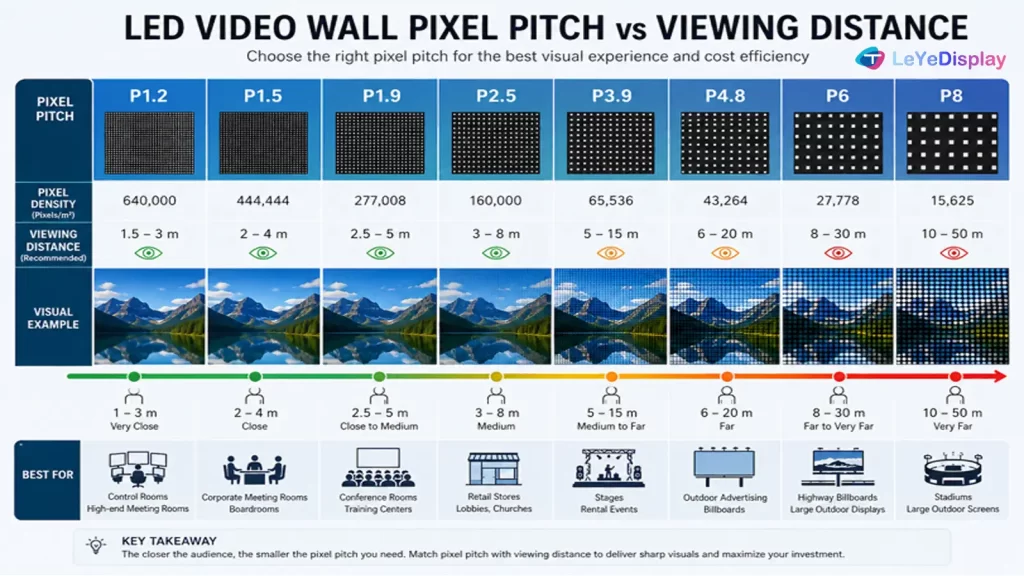
| Hauteur du pixel | Distance minimale de visionnage | Distance de visionnage recommandée | Applications typiques |
|---|---|---|---|
| P1.2 | 1,2 m | 1,5 à 3 m | Salles de contrôle, salles de réunion haut de gamme |
| P1.5 | 1,5 m | 2 à 4 m | Salles de réunion d'entreprise |
| P1.8 | 1,8 m | 2,5 à 5 m | Centres de conférences |
| P2.5 | 2,5 m | 3 à 8 m | Commerce de détail, Églises |
| P2.9 | 2,9 m | 4 à 10 m | Événements liés à la location |
| P3.9 | 3,9 m | 5 à 15 m | Demandes de location et de mise à disposition de scènes |
| P4.8 | 4,8 m | 6 à 20 m | Publicité extérieure |
| P6 | 6 m | 8 à 30 m | Panneaux d'affichage |
| P8 | 8 m | 10 à 50 m | Grands écrans d'extérieur |
Pour la plupart des installations commerciales en intérieur, les modèles P1,5 à P2,5 offrent le meilleur compromis entre qualité d'image et budget. Les pas de pixel plus importants sont généralement privilégiés pour les applications de location et en extérieur, où les distances de visionnage sont plus importantes.
Cependant, les projets modernes ont souvent recours à des normes plus prudentes, en fonction des exigences en matière de qualité du contenu.
Pas de pixel recommandé selon l'application
Le pas de pixel idéal d'un mur vidéo LED varie en fonction des exigences de l'application.
Le tableau ci-dessous présente un résumé des caractéristiques techniques les plus couramment recommandées pour diverses applications d'écrans LED.
La conception d'affichages en fonction des applications est désormais une approche courante dans le secteur audiovisuel professionnel, où la distance de visionnage, le type de contenu et les attentes du public sont évalués conjointement.
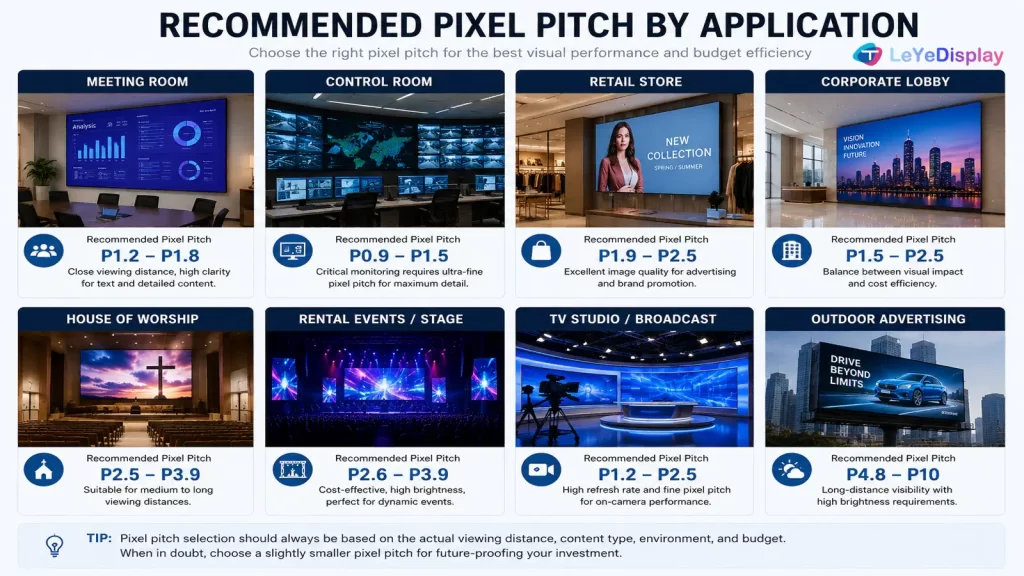
| Application | Pas de pixel recommandé | Raison |
|---|---|---|
| Salle de réunion | P1.2–P1.8 | Distance de visionnage rapprochée |
| Hall d'entrée de l'entreprise | P1,5–P2,5 | Trouver le juste équilibre entre qualité et budget |
| Salle de contrôle | P0,9–P1,5 | Détail visuel essentiel |
| Magasin de détail | P1,9–P2,5 | Publicité de grande qualité |
| Lieu de culte | P2.5-P3.9 | Distance de visionnage moyenne |
| Événements liés à la location | P2,6–P3,9 | Économique et polyvalent |
| Studio de télévision | P1.2–P2.5 | Des performances adaptées à l'appareil photo |
| Publicité extérieure | P4.8–P10 | Observation à distance |
Bien que ces recommandations constituent un point de départ utile, le choix du pas de pixel doit toujours tenir compte des conditions de visionnage spécifiques au projet et des exigences liées au contenu.
Pas de pixel et résolution
De nombreux acheteurs pensent qu'un écran LED plus grand offre automatiquement une meilleure résolution.
En réalité, la résolution dépend à la fois de la taille de l'écran et du pas de pixel. Un même écran peut offrir une qualité d'image très différente selon le pas de pixel sélectionné.
Écran de 4 m × 2,5 m
| Hauteur du pixel | Résolution approximative (L × H) | Nombre total de pixels |
|---|---|---|
| P1.2 | 3333 × 2083 | 6,94 millions |
| P1.5 | 2667 × 1667 | 4,44 millions |
| P1.9 | 2105 × 1316 | 2,77 millions |
| P2.5 | 1600 × 1000 | 1,60 million |
| P3.9 | 1026 × 641 | 0,66 million |
À mesure que le pas de pixel diminue, la densité de pixels augmente considérablement. Cela permet à l'écran de restituer des détails plus fins, un texte plus net et des images plus fluides, en particulier lorsque l'on regarde de près.
Erreurs courantes commises par les acheteurs concernant le pas de pixel
De nombreux projets d'éclairage LED dépassent le budget prévu ou ne répondent pas aux attentes, car les acheteurs ne comprennent pas bien comment choisir le pas de pixel.
Les erreurs suivantes comptent parmi les plus courantes dans les projets d'écrans LED commerciaux.
| Erreur | Résultat |
|---|---|
| Choisir le pas le plus petit disponible | Dépenses superflues |
| Ignorer la distance d'observation | Faible retour sur investissement |
| Choisir uniquement en fonction du prix | Qualité d'image insatisfaisante |
| Copier le cahier des charges d'un autre projet | Des performances inégales |
| Ne pas tenir compte des besoins futurs en matière de contenu | Des mises à niveau coûteuses par la suite |
Éviter ces erreurs courantes peut améliorer considérablement à la fois les performances du projet et le retour sur investissement à long terme.
Densité de pixels ou budget : trouver le juste équilibre
Des pas de pixels plus petits offrent une meilleure qualité d'image, mais ils augmentent également le coût du projet. La plupart des projets LED réussis trouvent un équilibre entre performances visuelles et budget, plutôt que de se contenter de choisir le pas le plus petit disponible.
| Hauteur du pixel | Qualité d'image | Distance d'observation | Coût relatif |
|---|---|---|---|
| P1.2 | Excellent | Très proche | $$$$$ |
| P1.5 | Excellent | Fermer | $$$$ |
| P1.9 | Très bon | Moyen | $$$ |
| P2.5 | Bon | Moyen-long | $$ |
| P3.9 | Bon | Longues | $ |
| P4.8+ | Acceptable | Très long | $ |
Pour de nombreux projets commerciaux en intérieur en 2026, les pas de pixel compris entre P1,5 et P1,9 restent le choix le plus populaire, car ils offrent une excellente qualité d'image sans le surcoût lié aux pas de pixel ultra-fins.
Comment le pas de pixel s'articule avec les autres caractéristiques techniques des LED
Le pas de pixel ne doit jamais être évalué isolément.
Les acheteurs professionnels prennent également en compte :
- Guide de luminosité
- Guide sur les fréquences de rafraîchissement
- Guide de consommation électrique
- Guide sur la durée de vie
- Guide comparatif COB vs SMD
La réussite d'un projet d'éclairage LED repose sur l'équilibre entre tous ces facteurs plutôt que sur l'optimisation d'une seule caractéristique technique.
Pour disposer d'un cadre d'achat complet, consultez notre guide d'achat sur les murs vidéo LED.
Questions fréquemment posées
Pour la plupart des applications commerciales en intérieur, les modèles P1.5 à P2.5 offrent un excellent compromis entre qualité d'image et coût.
Une règle générale est la suivante :
Distance de visionnage (mètres) ≈ Pas de pixel (mm)
Il convient toutefois de tenir compte également du type de contenu et des attentes des utilisateurs.
Non.
Un pas de pixel plus petit augmente considérablement le coût et peut n'apporter que peu d'avantages concrets si les spectateurs se trouvent loin de l'écran.
Les modèles P2.6, P2.9 et P3.9 resteront les choix les plus courants pour les applications de location en 2026.
Le choix d'un pas de pixel adapté pour un mur vidéo LED a une incidence directe sur la qualité de l'image, l'expérience visuelle et le coût global du projet.
Le choix d'un pas de pixel adapté a une incidence sur la qualité de l'image, l'expérience visuelle, le budget du projet et la satisfaction à long terme.
Au lieu de se concentrer uniquement sur le pas de pixel le plus petit disponible, les acheteurs devraient tenir compte de la distance de visionnage, des exigences liées à l'application, des besoins futurs en matière de contenu et du coût total du projet.
En comprenant comment le pas de pixel interagit avec la luminosité, la fréquence de rafraîchissement, la technologie d'affichage et l'environnement d'installation, vous pourrez choisir en toute confiance la meilleure solution de mur vidéo LED pour votre projet en 2026.