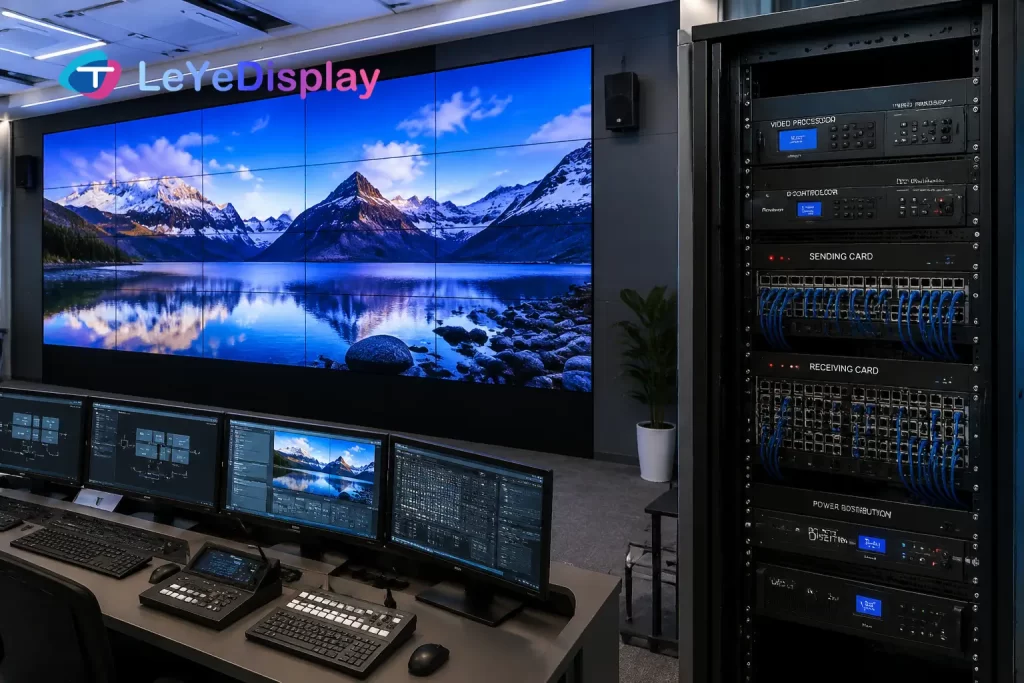
In professional LED video wall projects, the LED video wall control system is one of the key elements that determines how effectively the entire display solution performs.
Behind every stable and high-performance LED installation, there is a carefully designed control system responsible for signal processing, image quality, content management, and long-term reliability.
Many buyers initially focus on visible factors such as pixel pitch, brightness, cabinet design, and display performance. However, during real project implementation, another question becomes equally important:
How should the control system be selected to ensure the LED video wall performs as expected?
From our experience as an LED video wall manufacturer, we have learned that control system selection is not simply about choosing a controller model.
It requires a complete understanding of:
- Display specifications
- Application requirements
- Signal sources
- 설치 환경
- Long-term operational expectations
A successful LED video wall project is not created by one component.
It is created by how all components work together, from display hardware and signal processing to installation requirements and project-specific design.
This is why professional LED 비디오 월 솔루션 are increasingly focused on system integration rather than individual products.
What Is an LED Video Wall Control System?
An LED video wall control system is the technology infrastructure that manages how visual content is processed, transmitted, and displayed on an LED screen. It connects different hardware components to ensure stable image output and reliable operation.
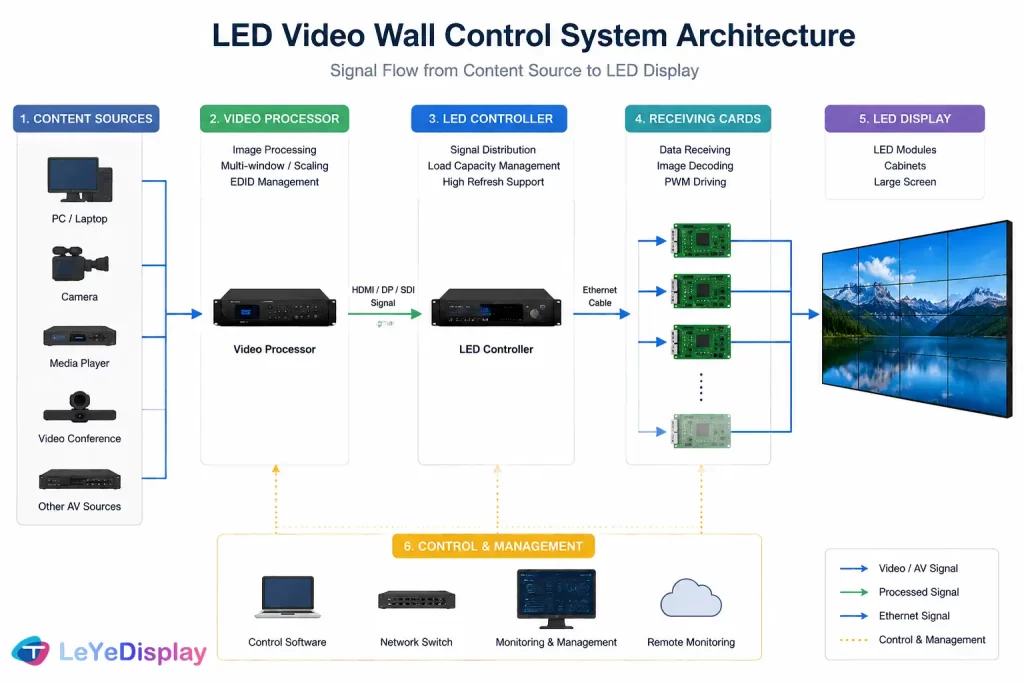
Although the controller is an important part of the system, the complete control architecture usually includes multiple components, such as:
- LED video wall controllers
- Video processors
- Sending cards
- Receiving cards
- Signal management devices
- Control software
Together, these components ensure that the content source is correctly converted into the format required by the LED display.
For example, a large fine-pitch LED video wall installed in a control room may require completely different control capabilities compared with a small corporate meeting room display.
The screen size, resolution, content source, and operating environment all influence the final system design.
This is why professional LED projects require more than simply selecting a hardware device.
They require a complete control solution. (LED display control system technology)
Why Control Systems Matter in LED Video Wall Projects
A high-quality LED display depends not only on the LED modules and cabinets.
The control system directly influences the final viewing experience and operational stability.
Image Quality and Performance
The control system determines how accurately visual information is processed and displayed.
Important factors include:
- Resolution matching
- 색상 일관성
- Grayscale performance
- 새로 고침 빈도
- Signal accuracy
For fine-pitch LED displays used in meeting rooms, studios, and command centers, even small differences in signal processing can affect the overall viewing experience.
Stable Operation
For many professional applications, LED displays operate continuously for many hours every day.
In these environments, reliability becomes just as important as image quality.
A suitable control system helps ensure:
- Stable signal transmission
- Reduced downtime risk
- Better system compatibility
- Easier maintenance
이는 특히 다음과 같은 경우에 중요합니다:
- 제어실
- Transportation monitoring centers
- Broadcast environments
- Large commercial installations
Flexible Content Management
Modern LED video wall projects often require multiple content sources.
예를 들면 다음과 같습니다:
- Computers
- Cameras
- Video conferencing systems
- Broadcast signals
- Multiple image windows
A properly designed control system allows users to manage different sources efficiently and provides greater flexibility during daily operation.
Key Factors When Selecting an LED Video Wall Control System
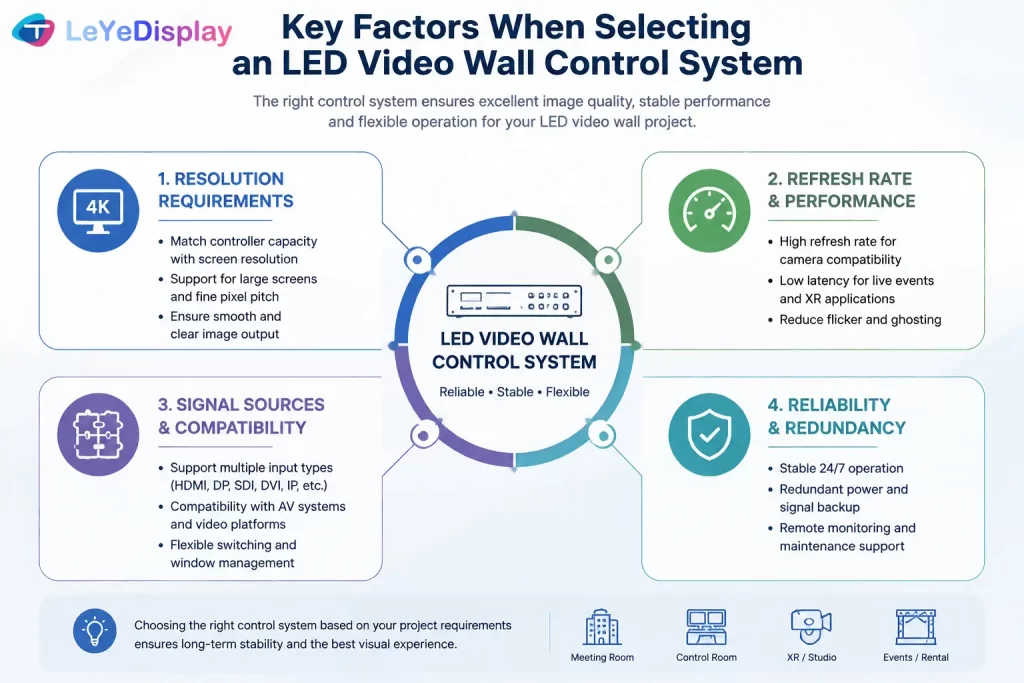
Choosing the right LED video wall control system depends on more than selecting a controller. It requires understanding resolution requirements, signal sources, application environments, and long-term reliability.
There is no single solution that fits every LED installation.
1. Display Resolution Requirements
One of the first considerations is the relationship between the control system and the LED display resolution.
Larger LED walls and finer pixel pitches require stronger processing capabilities.
예를 들어
- A small meeting room display may require a simpler configuration.
- A large control room LED wall may require advanced processing and multiple signal management capabilities.
The control system should always be matched with the actual display specification.
2. Refresh Rate and Camera Performance
Refresh rate has become increasingly important as LED displays are used in more demanding environments.
Applications such as:
- XR virtual production
- 방송 스튜디오
- 라이브 이벤트
often require excellent camera compatibility. ()
A suitable control system helps maintain smooth image performance and reduces visual issues during camera shooting.
For more details about refresh rate considerations, you can also refer to our guide on LED video wall refresh rate requirements.
3. Signal Sources and System Compatibility
Modern projects rarely rely on a single content source.
A professional LED video wall may need to support:
- HDMI input
- DisplayPort
- SDI signals
- Camera systems
- Video conferencing platforms
- AV over IP systems
Therefore, control system selection should consider the entire signal workflow rather than only the LED display itself.
4. Reliability and Redundancy
For mission-critical applications, system reliability is a major consideration.
Control rooms, security centers, and command facilities often require:
- Backup systems
- Redundant signal paths
- Continuous operation capability
In these environments, control system design becomes part of the overall project reliability strategy.
Different Applications Require Different Control Solutions
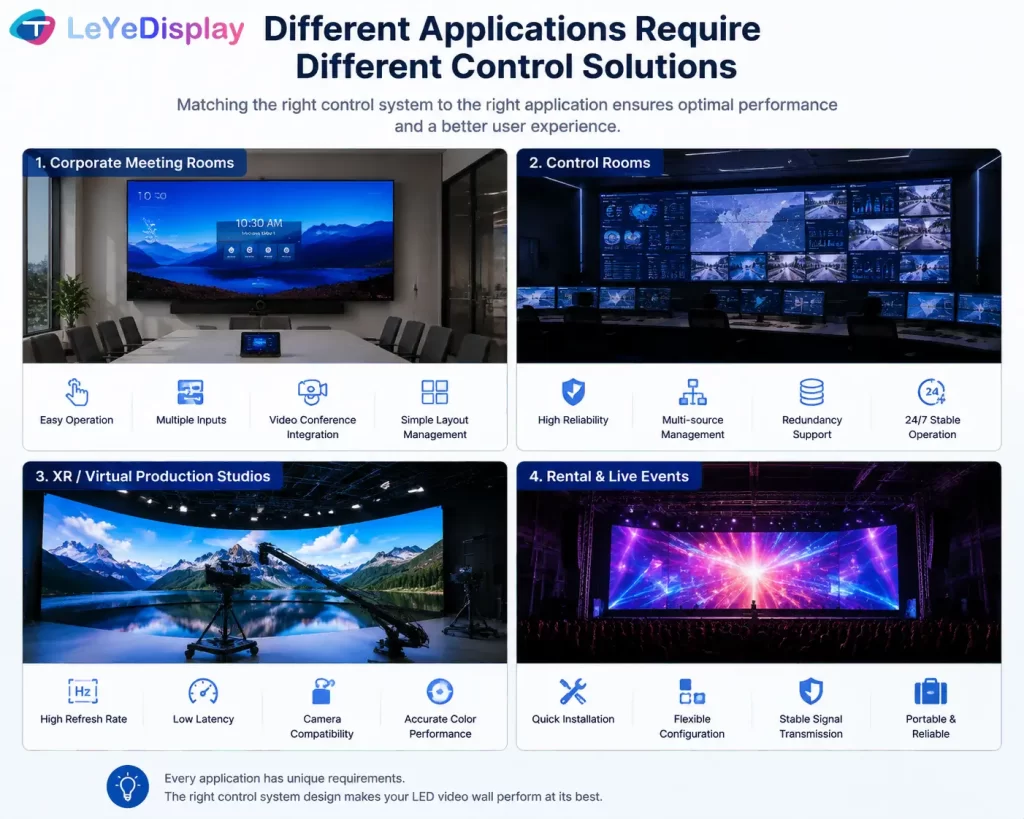
One important lesson from real projects is that different applications have different priorities.
The best control system is not necessarily the most advanced one.
It is the one that fits the project requirements.
기업용 회의실
Meeting room LED displays usually focus on:
- Simple operation
- Multiple input sources
- Video conferencing compatibility
- Easy content switching
For these applications, usability and integration are often more important than extremely complex processing capabilities.
The goal is to create a display system that works naturally within daily business operations.
You can learn more about our meeting room LED display project experience through one of our real installations, where a fine-pitch COB display was deployed for a corporate meeting environment.
제어실
Control room environments have much higher requirements.
Typical considerations include:
- Long operating hours
- High reliability
- Multiple signal sources
- Stable image performance
In these projects, the control system must support continuous operation and efficient information management.
A well-designed LED video wall system allows operators to monitor critical information clearly and reliably.
XR Virtual Production Studios
XR applications represent one of the most demanding LED display environments.
They require:
- High refresh performance
- Low latency
- Excellent camera compatibility
- Accurate image reproduction
As virtual production continues to grow, the relationship between LED displays and control systems becomes increasingly important.
The display is not only showing content.
It becomes part of the production environment.
Rental and Live Event Applications
Rental LED displays face different challenges.
They require:
- 빠른 배포
- Flexible configuration
- Stable performance under frequent installation
For touring events, concerts, and temporary installations, system reliability directly affects project success.
Hardware Controllers vs Software-Based Management Systems
Traditional LED control systems mainly focused on signal processing and basic display management.
Today, the requirements are expanding.
Modern LED projects increasingly involve:
- Remote monitoring
- Cloud-based management
- Intelligent calibration
- System diagnostics
As LED applications become more complex, control systems are evolving from simple signal devices into important parts of overall display management.
How We Select and Validate Control Systems for LED Projects
As an LED video wall manufacturer, our approach is not simply selecting a controller and combining it with a display.
Every project starts from understanding the actual application and selecting an LED video wall control system that matches the display requirements.
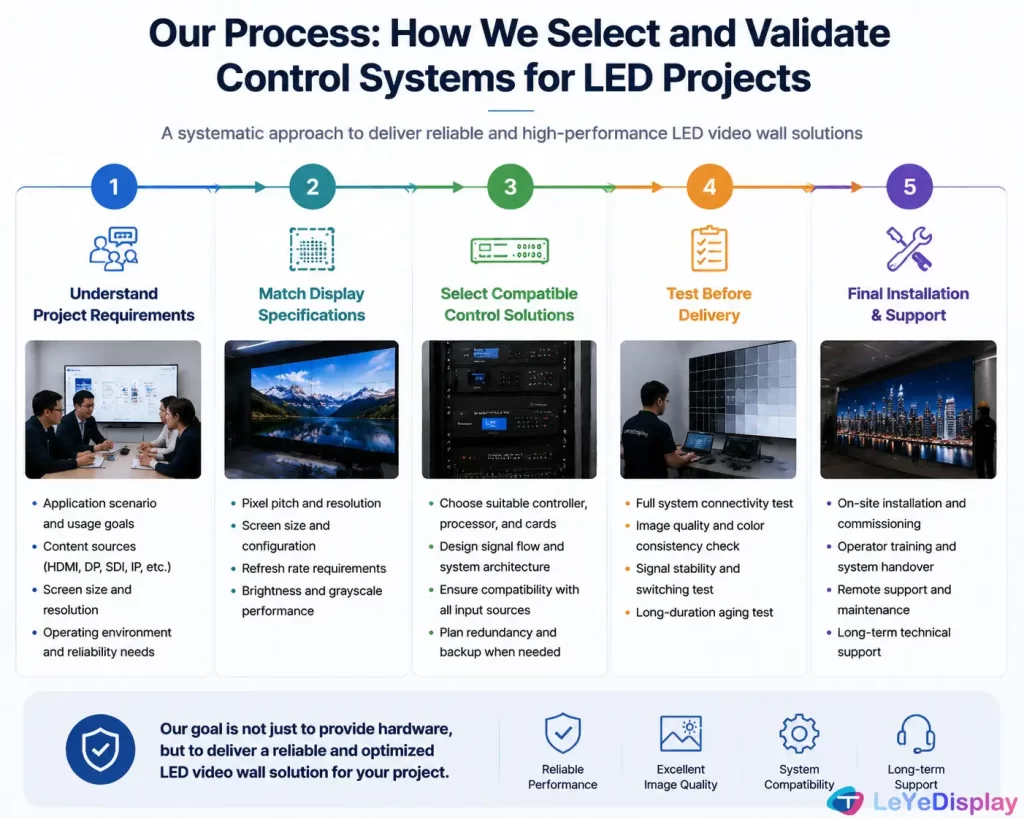
Our process usually includes:
Step 1: Understand Project Requirements
We evaluate:
- 애플리케이션 시나리오
- 시야 거리
- Content sources
- 운영 환경
Step 2: Match Display Specifications
We consider:
- 픽셀 피치
- 화면 크기
- 해상도
- Refresh requirements
Step 3: Select Compatible Control Solutions
Based on project requirements, we match suitable:
- Controllers
- Video processors
- Signal management solutions
Step 4: Verify System Compatibility
Before delivery, the complete system is tested to ensure:
- Stable operation
- Image consistency
- Signal compatibility
The goal is not simply to provide individual components.
The goal is to deliver a reliable LED video wall solution.
Control Systems We Work With
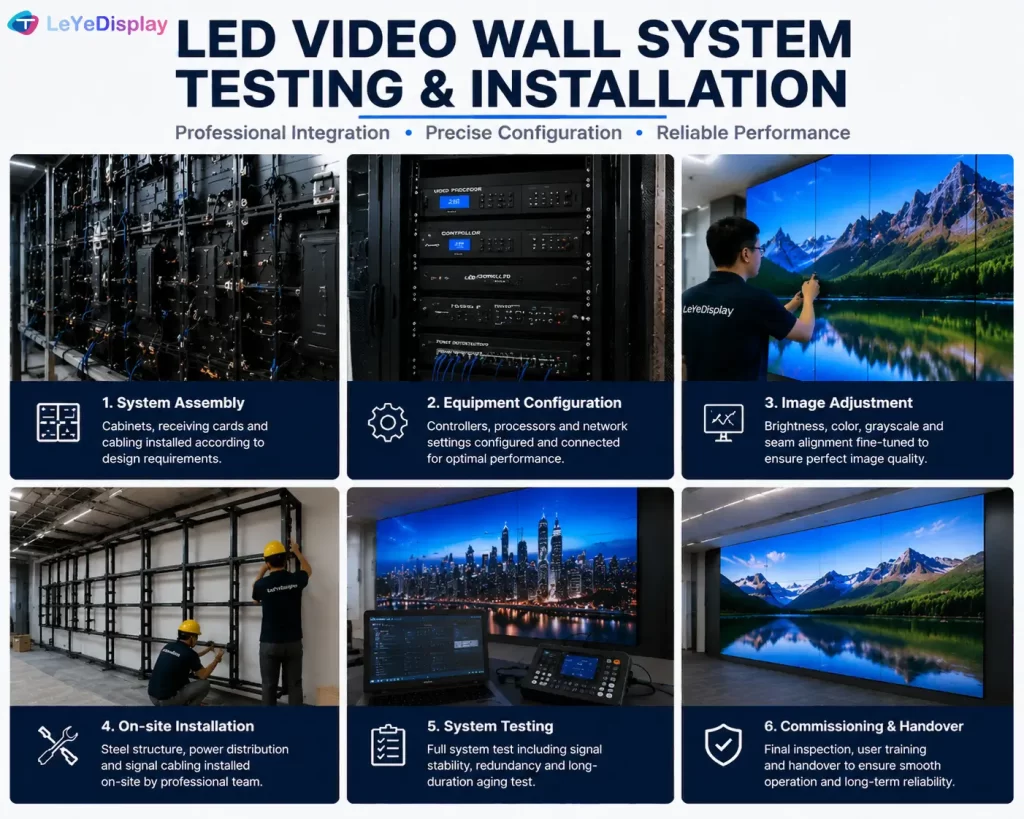
Different LED projects require different technical approaches.
Depending on application requirements, we work with professional control system solutions that have been verified through real LED display projects.
The selection depends on factors such as:
- Display specifications
- Project environment
- Signal requirements
- Customer expectations
Rather than focusing on a specific brand, our priority is ensuring that the complete LED video wall system operates reliably.
자주 묻는 질문
Do LED video walls need a control system?
Yes. A control system is essential for processing signals and ensuring that content is displayed correctly on an LED video wall.
What is the difference between an LED controller and a control system?
An LED controller is one component of a complete control system. A complete solution may also include processors, signal management devices, software, and other supporting technologies.
How do I choose the right control system for an LED video wall?
The right choice depends on factors such as screen size, resolution, application requirements, signal sources, and operational expectations.
Can an LED manufacturer help with control system selection?
Yes. Experienced LED manufacturers can help match suitable control solutions based on the display design and project requirements.
최종 생각
A successful LED video wall project is not only determined by the display hardware itself.
The control system, signal architecture, and compatibility between different components all influence the final performance.
This is why professional LED projects require a solution-oriented approach.
As an LED video wall manufacturer, we combine display manufacturing experience with real project requirements to help customers create reliable and customized LED solutions.
The goal is not simply to provide a screen.
The goal is to deliver a complete LED video wall system designed for real-world applications.