An LED display quotation comparison is not simply about finding the lowest price. Two suppliers may offer the same pixel pitch, screen size, and refresh rate, yet their quotations can differ significantly in components, control systems, installation requirements, warranty coverage, and total project cost.
For system integrators, distributors, and project buyers, the real challenge is determining whether two LED display proposals are actually comparable.
Quick Answer: Before comparing LED display prices, confirm that both quotations cover the same technical specifications, component quality, maintenance design, control system, installation accessories, spare parts, warranty terms, and delivery scope. A lower quotation does not necessarily mean a lower total project cost.
This guide explains eight practical checks to help you evaluate competing offers and make a more informed purchasing decision.
Why LED Display Quotations Can Be Difficult to Compare
Unlike a standard consumer product, an LED display is usually configured around specific project requirements.
Even when two suppliers quote the same screen dimensions and pixel pitch, their solutions may differ in several important ways.
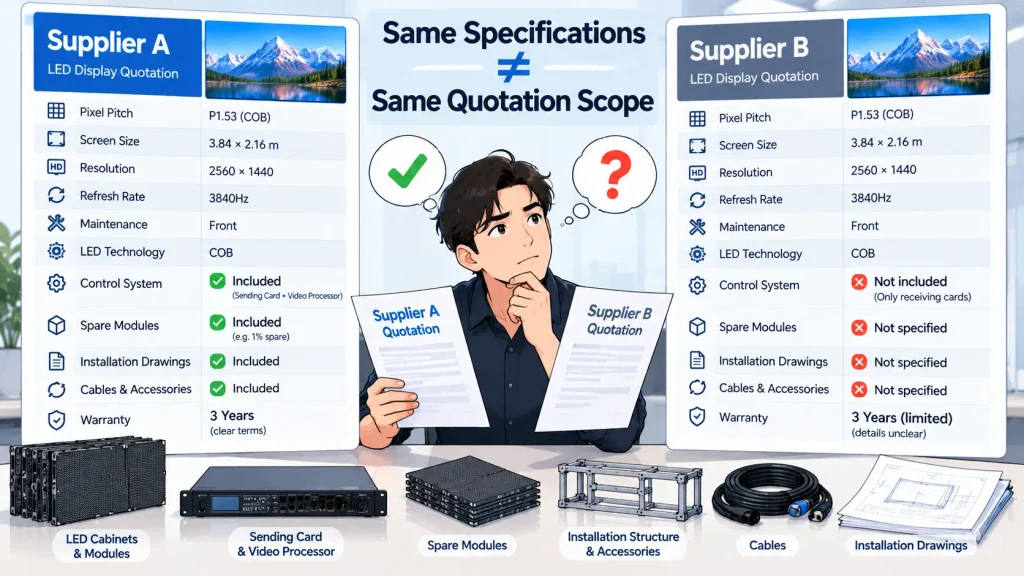
For example, one supplier may include a video processor, spare modules, and installation drawings, while another quotes only the LED cabinets and basic receiving cards.
Both proposals may appear technically similar, but they do not represent the same delivery scope.
A useful LED display quotation comparison therefore requires buyers to examine what is included, what is excluded, and whether the proposed system can meet the actual project requirements.
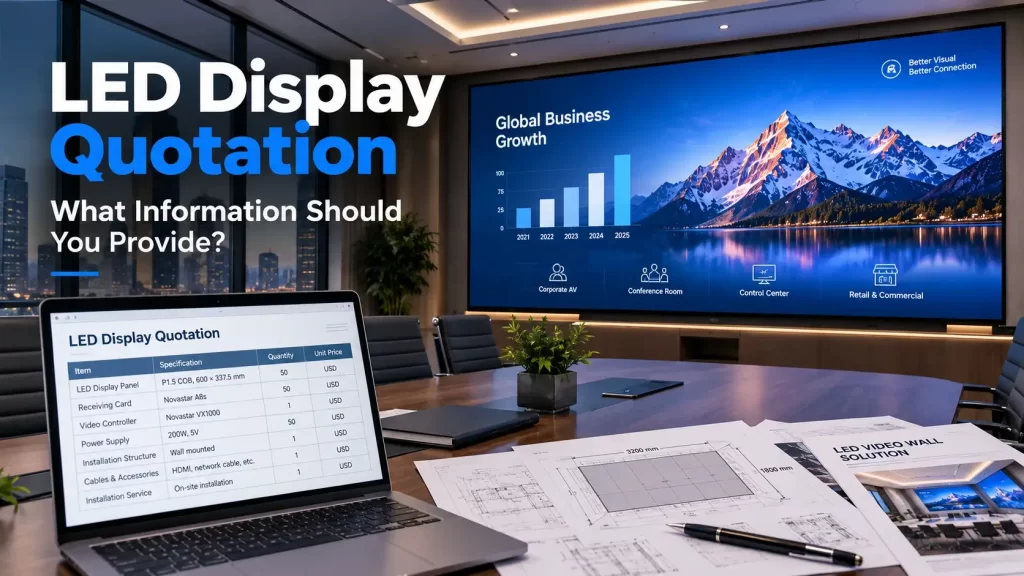
Before requesting prices, buyers should also understand what information to provide for an accurate LED display quotation so that suppliers can prepare proposals based on consistent project requirements.
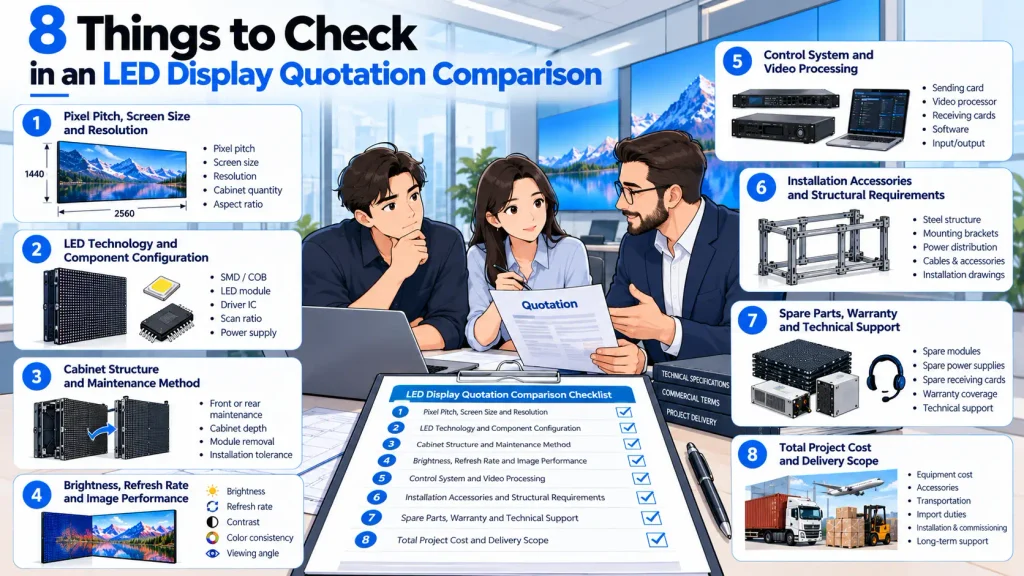
8 Things to Check in an LED Display Quotation Comparison
1. Pixel Pitch, Screen Size, and Resolution
Start by confirming that both quotations describe the same display configuration.
Check the following:
- درجة البكسل
- Actual display width and height
- Total display area
- Cabinet dimensions and quantity
- Overall pixel resolution
- نسبة العرض إلى الارتفاع
A small difference in screen dimensions may affect the number of cabinets, total resolution, and installation structure.
For example, two quotations may both specify P1.5, but different cabinet dimensions can produce different final screen sizes and pixel resolutions.
Buyers should compare the actual display configuration rather than relying only on the nominal pixel pitch.
Professional AV system planning also considers display image size and viewing positions. The AVIXA display image size standard provides a framework for evaluating these requirements according to the intended viewing tasks.
What to ask: Can the supplier provide a cabinet layout drawing showing the final screen dimensions and resolution?
2. LED Technology and Component Configuration
The LED package and driving components directly influence display performance, reliability, and maintenance requirements.
For indoor applications, suppliers may offer SMD, COB, or other LED packaging technologies depending on the project.
However, even two COB displays with the same pixel pitch may use different module designs and driver configurations.
Important items include:
- LED packaging technology
- LED module specifications
- طراز IC للسائق
- نسبة المسح الضوئي
- أداء التدرج الرمادي
- Power supply configuration
- Module and cabinet construction
For projects requiring close viewing distances, long operating hours, or demanding camera performance, these differences deserve careful evaluation.
An effective LED display quotation comparison should therefore consider component configuration alongside the advertised specifications.
What to ask: Can the supplier confirm the main component specifications and explain how they support the intended application?
3. Cabinet Structure and Maintenance Method
Cabinet design affects installation, maintenance access, and long-term service costs.
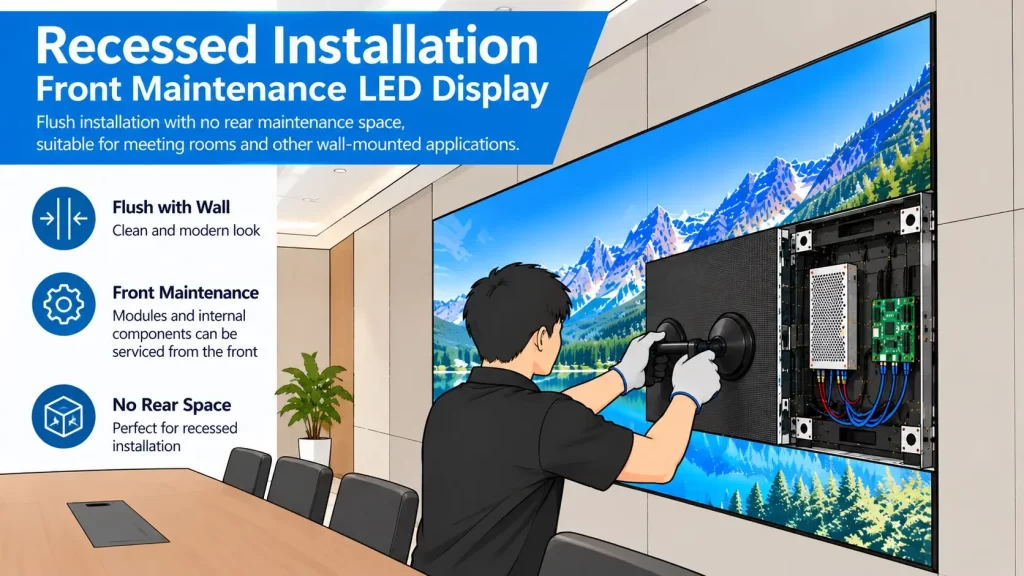
A front-maintenance LED display may be suitable for wall-mounted or recessed installations where rear access is unavailable.
Rear-maintenance cabinets can be practical when a dedicated service corridor or permanent rear access is available.
Neither approach is automatically better.
Understanding the differences between front maintenance and rear maintenance LED displays can help buyers evaluate installation space, structural requirements, and future service access.
The correct choice depends on the installation environment.
When reviewing quotations, check:
- مواد الخزانة
- Cabinet dimensions and depth
- Front or rear maintenance
- Module removal method
- Power supply and receiving card access
- Installation tolerances
- Structural compatibility
A lower-priced cabinet may become expensive if the installation site requires structural modifications or additional maintenance space.
What to ask: Can all required components be serviced safely after the screen is installed?
4. Brightness, Refresh Rate, and Image Performance
Display performance should be evaluated according to the actual operating environment.
For indoor meeting rooms, excessive brightness may be unnecessary. For outdoor applications, sufficient brightness under strong ambient light becomes much more important.
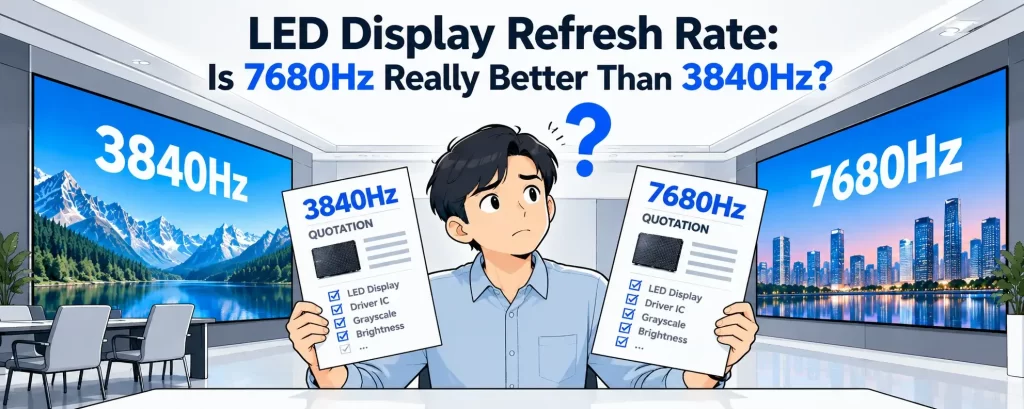
Similarly, a higher refresh rate does not automatically guarantee better image quality.
Compare:
- Typical and maximum brightness
- معدل التحديث
- أداء التدرج الرمادي
- Contrast and black-level performance
- تناسق الألوان
- Viewing angle
- Expected operating conditions
For most conventional indoor applications, a properly configured 3840Hz display can provide excellent performance.
For broadcast, XR, and camera-intensive applications, higher refresh rates and additional camera testing may be appropriate.
A meaningful LED display quotation comparison evaluates these specifications together rather than treating the highest number as the best solution.
What to ask: Are the quoted performance specifications achievable under the proposed operating configuration?
5. Control System and Video Processing
This is one of the most commonly overlooked differences between LED display quotations.
Some suppliers include only the receiving cards installed inside the LED cabinets.
Others may include a complete control system with sending equipment, video processing, and required accessories.
Before comparing prices, confirm whether the quotation includes:
- استلام البطاقات
- Sending controller
- Video processor
- Required input and output interfaces
- برنامج التحكم
- Signal cables
- System configuration support
The control system should also match the required resolution, signal sources, operating workflow, and future expansion requirements.
A quotation without a required video processor may initially appear cheaper, but the missing equipment must still be purchased.
What to ask: Does the quotation include everything necessary to receive the intended video sources and operate the complete LED wall?
6. Installation Accessories and Structural Requirements
An LED display cannot be evaluated independently of its installation environment.
Depending on the project, additional items may include:
- Steel mounting structure
- Wall-mounting brackets
- Power distribution equipment
- Signal and power cables
- Connection accessories
- رسومات التركيب
- Custom mounting components
For recessed installations, the available depth, steel structure, cable routing, and maintenance method should be confirmed before production.
For outdoor installations, structural loading, weather protection, and site conditions may introduce additional requirements.
During an LED display quotation comparison, buyers should clearly distinguish between equipment supply and a complete installed solution.
What to ask: Which installation materials and engineering services are included, and which remain the buyer’s responsibility?
7. Spare Parts, Warranty, and Technical Support
Warranty terms can look similar on paper while providing very different levels of practical support.
For example, two suppliers may both offer a three-year warranty, but their policies may differ regarding replacement parts, shipping costs, labor, response times, and exclusions.
Review:
- Warranty duration
- Warranty coverage
- Spare LED modules
- Spare power supplies
- Spare receiving cards
- Technical support availability
- Replacement procedures
- Responsibility for shipping and labor
For international projects, it is especially important to understand how defective components will be handled after installation.
A professional supplier should be able to explain the service process before an order is confirmed.
What to ask: If a module fails after installation, what exactly happens next, and who pays for each part of the service process?
8. Total Project Cost and Delivery Scope
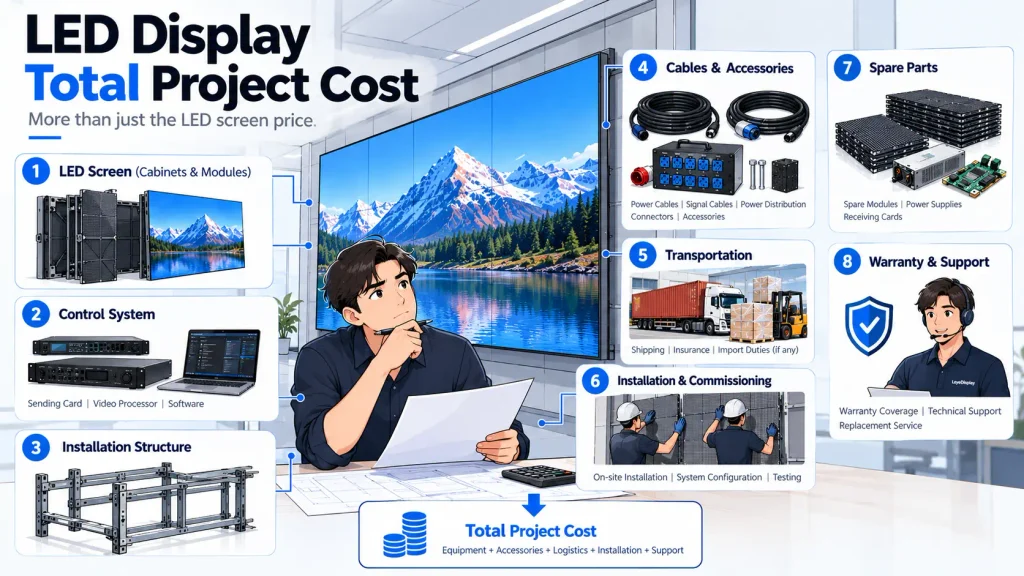
The final comparison should focus on total project cost rather than the quoted LED screen price alone.
Understanding the factors behind تسعير حائط فيديو LED can also help buyers identify differences between equipment costs and the total project budget.
Depending on the commercial terms and project scope, additional costs may include:
- Video processing equipment
- هيكل التركيب
- Spare parts
- Transportation
- Import duties and taxes
- Local installation labor
- Equipment commissioning
- On-site technical support
- Future maintenance
Delivery terms also matter.
Under the Incoterms 2020 rules, EXW and DDP involve different responsibilities for transportation, customs clearance, duties, and delivery. Buyers should confirm the agreed Incoterm and named place before comparing quotations.
Comparing their headline prices without adjusting for these differences can produce misleading conclusions.
The final stage of an LED display quotation comparison should therefore identify the total cost required to deliver a functional system under equivalent commercial conditions.
What to ask: What is the complete estimated cost to get the LED display installed, commissioned, and ready for operation?
Example: Comparing Two LED Display Quotations
Consider a hypothetical indoor meeting-room project.
Two suppliers propose a P1.53 COB LED display with a 3840Hz refresh rate and front maintenance.
At first glance, their offers appear almost identical.
However, a closer examination reveals important differences.
| Comparison Item | Supplier A | Supplier B |
|---|---|---|
| درجة البكسل | P1.53 | P1.53 |
| تقنية LED | كوب | كوب |
| معدل التحديث | 3840 هرتز | 3840 هرتز |
| الصيانة | الواجهة | الواجهة |
| Video processor | Included | Not included |
| Spare LED modules | Included | Not specified |
| رسومات التركيب | Included | Not specified |
| Warranty | 3 years, terms provided | 3 years, coverage unclear |
| الشحن | EXW | EXW |
Illustrative example only. These are hypothetical supplier offers, not actual quotations.
Suppose Supplier B offers a lower initial price.
Does that make Supplier B the better choice?
ليس بالضرورة.
Before deciding, the buyer should confirm the cost of the missing video processor, required spare parts, and any engineering services that are not included.
The buyer should also verify whether the two systems use comparable components and can meet the same performance requirements.
After these differences are clarified, Supplier B may still provide the better value.
Alternatively, Supplier A’s more complete package may prove more economical.
The purpose of an LED display quotation comparison is not to identify the supplier with the longest equipment list. It is to establish equivalent requirements and compare the cost and value of meeting them.
How to Make Two LED Display Quotations Truly Comparable
A practical approach is to prepare one comparison sheet and ask each supplier to confirm the same requirements.
Use three categories:
1. Required specifications
These are the technical conditions the project must meet, such as pixel pitch, resolution, brightness, maintenance method, and compatibility.
2. Included equipment and services
These cover controllers, processors, spare parts, mounting accessories, documentation, and technical support.
3. Commercial conditions
These include delivery terms, warranty coverage, payment conditions, production lead time, and responsibilities after delivery.
When a quotation contains unclear information, mark it as “Not Specified” rather than assuming the item is included.
This simple practice prevents missing information from being mistaken for equivalent performance or delivery scope.
It also makes communication with suppliers more efficient.
Common Mistakes When Comparing LED Display Prices
Several mistakes can lead to unnecessary costs or unsuitable equipment.
Comparing Only Price per Square Meter
Price per square meter can be useful for an initial budget estimate, but it does not necessarily include controllers, accessories, installation, or other project-specific requirements.
Assuming Identical Specifications Mean Identical Performance
Two products may both advertise 3840Hz, 16-bit grayscale, or the same brightness level, yet use different components and operating configurations.
Ignoring Maintenance Access
A display that fits the installation opening may still be difficult or impossible to service after installation.
Overlooking Excluded Equipment
A quotation may exclude video processing, mounting structures, power distribution, or spare parts.
Choosing the Highest Specification Automatically
A more expensive configuration is not always necessary.
The correct specifications should be based on viewing conditions, content, installation environment, and operating requirements.
Avoiding these mistakes makes an LED display quotation comparison more accurate and reduces the risk of unexpected project expenses.
Final Checklist Before Choosing an LED Display Supplier
Before approving a quotation, confirm that you can answer these questions:
- Are the final screen dimensions and pixel resolutions equivalent?
- Are the LED technology and main components clearly specified?
- Does the maintenance design match the installation environment?
- Are brightness, refresh rate, and grayscale appropriate for the application?
- Is the required control system included?
- Are installation accessories and engineering responsibilities clear?
- Are spare parts, warranty coverage, and support procedures documented?
- Have shipping, taxes, installation, and other project costs been considered?
If several answers remain unclear, request clarification before making a final decision.
A reliable LED display quotation comparison should leave the buyer with a clear understanding of what will be delivered, how the system will operate, and what responsibilities remain after purchase.
Conclusion: Compare Project Value, Not Just LED Display Prices
The lowest quotation is not always the least expensive solution, and the highest quotation is not necessarily the best.
A suitable LED display proposal should meet the project requirements, provide a clear equipment and service scope, and offer reasonable long-term operating value.
For system integrators and project buyers, the most effective purchasing decision comes from comparing equivalent solutions under clearly defined technical and commercial conditions.
A good LED display quotation comparison helps buyers choose the right complete system—not simply the lowest number on a quotation sheet.
For a broader understanding of LED screen specifications, installation planning, and purchasing decisions, explore our دليل شراء شاشات الفيديو LED.
الأسئلة الشائعة
Why do LED display quotations vary so much between suppliers?
Differences may come from LED technology, component selection, cabinet design, control systems, accessories, warranty coverage, and delivery scope. Two quotations with the same pixel pitch may not represent equivalent systems.
Is the cheapest LED display quotation always a bad choice?
No. A lower quotation can provide excellent value if the system meets the project requirements and all necessary equipment and services are included. The important step is confirming that competing quotations are genuinely comparable.
What is the most important specification to compare in an LED display quotation?
There is no single specification that determines overall value. Pixel pitch, resolution, brightness, components, maintenance method, and control system should be considered together according to the application.
Should an LED display quotation include a video processor?
It depends on the control architecture and the project’s signal requirements. Some systems require a separate video processor, while others can operate with an appropriate integrated controller. Buyers should confirm the complete signal-processing solution rather than assume a separate processor is always required.
How can I compare LED display quotations from different manufacturers?
Create a standardized comparison sheet covering technical specifications, components, included equipment, installation requirements, warranty, delivery terms, and total project cost. Ask suppliers to clarify missing items before comparing their final offers.