
Retail spaces are becoming increasingly visual. From storefront advertising and promotional windows to large indoor video walls, LED technology gives retailers more flexibility to present products, campaigns, and brand messages.
ومع ذلك، فإن اختيار Retail LED Display is not simply a matter of selecting a screen with the right size or resolution. Different retail environments have different lighting conditions, viewing distances, installation limitations, and content requirements.
A display designed for a bright storefront may not be the best solution for an indoor brand wall. Similarly, a large video wall in a shopping mall requires different planning from a compact display inside a boutique.
This guide explains how system integrators, contractors, and retail project buyers can evaluate the main requirements before selecting an LED display solution.
1. Understand the Requirements of Different Retail Environments
Before selecting a display, identify where it will be installed and how customers will interact with it.
Retail environments can generally be divided into several categories.
| Retail environment | Typical application | Main considerations |
|---|---|---|
| Storefront and shop windows | Promotions and product advertising | Ambient light, transparency, viewing distance |
| Shopping mall interiors | Brand advertising and large video walls | Screen size, viewing angles, brightness |
| Fashion and luxury stores | Brand storytelling and visual presentations | Image quality, color consistency, design integration |
| Supermarkets and department stores | Promotions and product information | Content visibility, operating hours, maintenance |
| Retail showrooms | Product demonstrations and immersive displays | Resolution, content detail, installation flexibility |
A Retail LED Display should be selected according to the actual environment rather than a general product specification.
For example, a storefront facing direct sunlight may require substantially higher brightness than an indoor display installed away from windows. A luxury showroom may prioritize fine pixel pitch and image consistency, while a large shopping mall advertising wall may place greater emphasis on screen dimensions and viewing distance.
The first step is therefore to define the application, viewing positions, lighting conditions, and available installation space. For a broader overview of LED display technologies and project selection, explore our دليل شراء شاشات الفيديو LED.
2. Storefront LED Displays: Visibility and Window Conditions
Storefront displays are often used to attract attention from pedestrians and passing vehicles. Their effectiveness depends on whether the content remains visible under changing outdoor lighting conditions.
For a storefront Retail LED Display, buyers should evaluate three factors.
Brightness and sunlight exposure
A display facing direct sunlight needs a different brightness configuration from one installed behind a shaded window. The glass itself can also introduce reflections and reduce perceived contrast.
The required brightness should be determined by the actual lighting conditions, screen orientation, and viewing distance. Simply choosing the highest available brightness is not always appropriate, as excessive brightness can increase power consumption and create an uncomfortable viewing experience.
Installation depth and window structure
Some storefronts have limited space between the glass and the interior of the store. The available depth, ventilation, mounting structure, and access for maintenance should be checked before selecting a cabinet or module design.
Transparency requirements
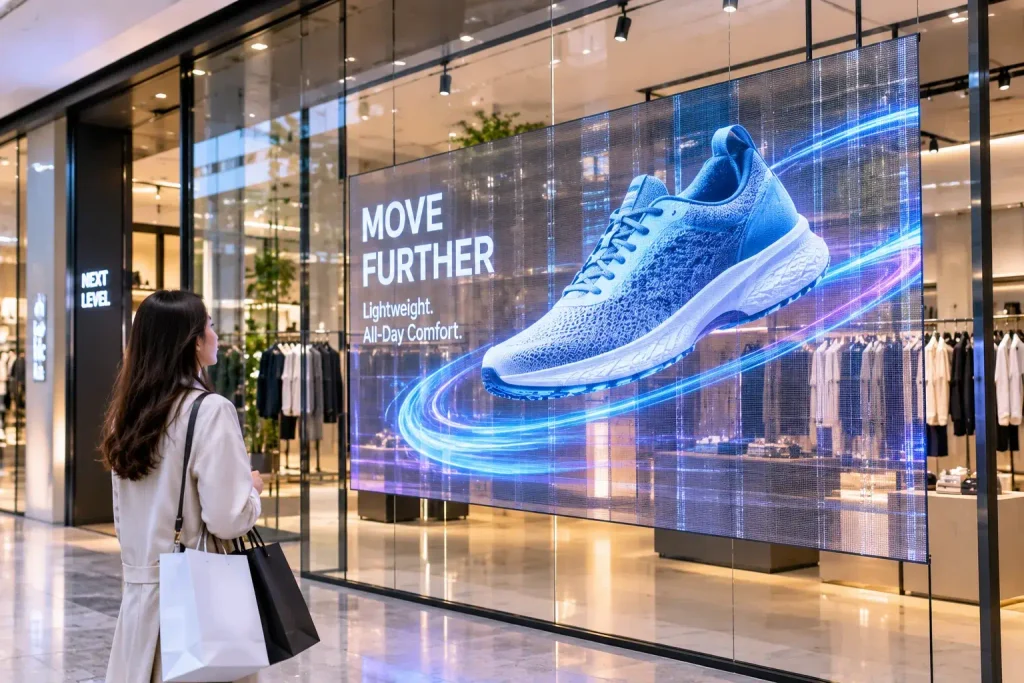
When retailers want to maintain visibility through the window, transparent LED displays may be considered. They can create digital advertising surfaces while allowing some degree of visibility through the screen.
However, transparency, brightness, pixel pitch, and viewing distance need to be evaluated together. A transparent display is not automatically the best choice for every storefront.
3. Indoor Retail LED Video Walls: Image Quality and Brand Presentation
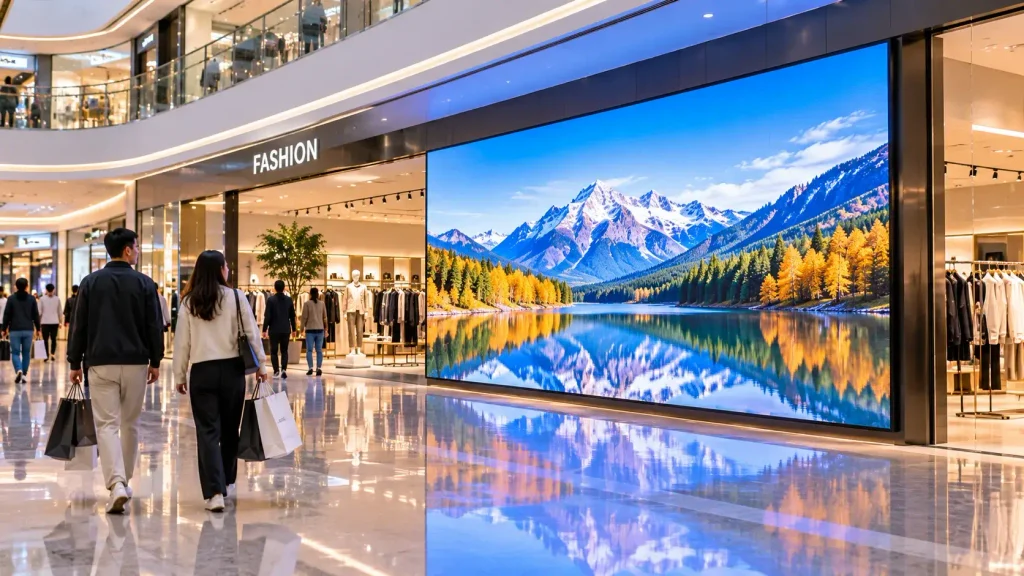
Indoor displays are commonly installed behind product counters, along feature walls, in shopping mall atriums, and inside brand showrooms.
Unlike storefront applications, indoor installations usually have more controlled lighting conditions. Image quality, viewing distance, screen proportions, and integration with the interior design become particularly important.
A large indoor LED video wall can provide a seamless visual surface for promotional campaigns, brand videos, product demonstrations, and seasonal content.
When planning an Indoor Retail LED Display, consider:
- The closest and farthest customer viewing positions.
- The level of detail required by the displayed content.
- The available wall dimensions and structural support.
- Whether the display will be viewed from multiple directions.
- How the screen will fit into the store’s architectural design.
For premium retail environments, fine-pitch LED technology may be suitable when customers view the screen from relatively close distances. For larger installations viewed from farther away, a wider pixel pitch may provide a more practical balance between image quality and project cost.
The display should support the intended customer experience without introducing unnecessary technical complexity. The right Retail LED Display configuration also depends on whether the screen is intended for detailed product presentations, general advertising, or large-scale brand content.
4. Pixel Pitch and Viewing Distance
Pixel pitch is one of the most important factors when specifying an LED display. It refers to the distance between the centers of two adjacent LED pixels, usually measured in millimeters.
For professional display planning, viewing positions and image size should also be evaluated together. The AVIXA V202.01:2026 standard provides a framework for determining display image size according to viewer requirements.
A smaller pixel pitch provides higher pixel density and can improve image detail when the screen is viewed at close range. However, it also generally increases the cost per square meter. For a more detailed explanation of how to match pixel pitch with viewing distance and screen resolution, see our guide to مسافة البكسل في جدار الفيديو LED.
For retail projects, pixel pitch should be evaluated based on actual viewing conditions rather than screen size alone.
| التطبيق | Typical viewing conditions | Pixel pitch considerations |
|---|---|---|
| Small boutique display | Close customer viewing | Fine-pitch LED may be appropriate |
| Indoor brand video wall | مسافة مشاهدة متوسطة | Balance detail and project budget |
| Shopping mall advertising wall | Longer viewing distance | Larger pixel pitch may be sufficient |
| Large retail atrium screen | Multiple viewing distances | Consider the farthest and closest positions |
These are general planning considerations, not fixed pixel-pitch standards. The correct specification depends on content resolution, viewing distance, screen dimensions, and visual expectations.
For example, a display showing detailed product images and text at close range may require a finer pixel pitch than a large promotional screen viewed from across a shopping mall.
System integrators should also consider the source content. A high-resolution LED display cannot create detail that is not present in the original video or image.
5. Brightness and Ambient Lighting
Lighting conditions have a direct impact on how customers perceive an LED display.
A screen that looks clear in a dim showroom may appear washed out when installed near large windows. Conversely, excessive brightness in a controlled indoor environment can cause discomfort and waste energy. For a more detailed comparison of brightness requirements across different installation environments, read our guide to سطوع شاشة LED.
Environmental factors such as direct sunlight, reflections, and changing ambient light should be considered during signage design. Accessibility Standards Canada’s signage guidelines also address display visibility, illumination adjustment, and reflective surfaces.
When specifying brightness for a Retail LED Display, evaluate the following conditions.
Storefront and window installations
Consider direct sunlight, reflected light, glass reflections, and the direction from which pedestrians view the screen.
Shopping mall and commercial interiors
Assess ceiling lighting, nearby windows, reflective surfaces, and the viewing distance from common walking areas.
Luxury retail and showrooms
Visual comfort, grayscale performance, color consistency, and contrast may be more important than maximum brightness.
Brightness should also be adjustable to suit different operating conditions. A suitable control strategy can help maintain visibility throughout the day without running the display at unnecessarily high output.
6. Screen Size, Installation, and Maintenance
The physical installation is just as important as the display specification.
A retail LED screen may be wall-mounted, suspended, recessed into a decorative structure, integrated into a storefront, or installed as a freestanding display.
Each method introduces different structural and maintenance requirements.
Before confirming the configuration, check:
- Available installation dimensions and tolerances.
- Wall load capacity and supporting structure.
- التهوية وتبديد الحرارة.
- Power distribution and cable routing.
- Access for front or rear maintenance.
- Space for the controller and other system equipment.
For locations where the rear of the display is inaccessible, a front-maintenance design may be necessary. This allows technicians to access selected modules or components from the front, reducing the need for rear service space. You can learn more about the differences between front and rear servicing in our guide to تصميم يتيح الصيانة من الأمام.
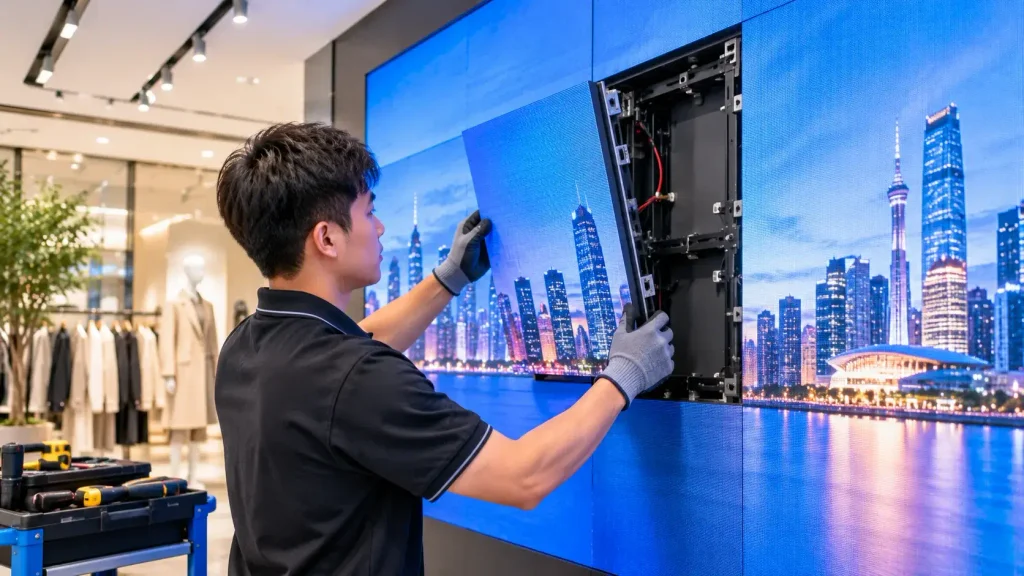
However, front maintenance is not automatically required for every retail project. The appropriate design depends on the installation structure, available access, and expected maintenance procedures.
A well-planned Retail LED Display installation should consider the entire service process, not just how the screen looks after installation. Maintenance access should be confirmed during the design stage rather than treated as an issue to solve after the display has been installed.
7. Content Management and System Integration
A retail display is only useful when the content can be delivered and managed reliably.
Depending on the project, the system may need to support:
- Promotional videos and product images.
- Scheduled advertising campaigns.
- Different content layouts and screen zones.
- Centralized content management across multiple stores.
- Integration with existing media players or control systems.
- Remote monitoring and operational status checks.
For a single-store installation, a relatively simple playback system may be sufficient. For a retail chain with multiple locations, centralized content management and remote control may be more important.
System integrators should confirm the required input signals, playback resolution, content formats, network conditions, and control responsibilities before finalizing the system architecture.
It is also important to clarify which functions are provided by the LED display system and which depend on external media players, software platforms, or third-party equipment.
For a multi-location Retail LED Display project, the control architecture should also account for how content is updated, scheduled, and monitored across different stores.
8. Common Mistakes When Planning a Retail LED Display
Some problems in retail LED projects do not come from the LED modules themselves. They result from incomplete project planning.
Choosing pixel pitch based only on budget
A lower-cost specification may not provide the required image detail at close viewing distances. Evaluate the actual viewing positions before comparing prices.
Ignoring ambient lighting
A display that performs well in a factory demonstration may look different in a bright storefront or shopping mall. Lighting conditions should be considered during specification.
Overlooking installation access
A screen installed inside a decorative wall may become difficult to maintain if access requirements are not considered during the design stage.
Selecting a screen before confirming the content system
The LED display, video processor, media player, and content management platform need to work together. Confirming only the screen specification can lead to integration problems later.
Treating every retail project as a standard installation
Different stores have different dimensions, architectural conditions, operating requirements, and customer viewing patterns. A standard cabinet configuration may not suit every project.
A successful retail installation starts with understanding these project-specific conditions before equipment selection.
Retail LED Display Project Planning Checklist
Before requesting a quotation or confirming an equipment configuration, review the following information:
- Retail application and installation location.
- Required screen width and height.
- Closest and farthest viewing distances.
- Indoor lighting and sunlight exposure.
- Preferred pixel pitch and image quality requirements.
- Wall structure, mounting method, and available space.
- إمكانية الوصول للصيانة من الأمام أو من الخلف.
- Content sources, playback requirements, and control system.
- Expected operating hours and maintenance arrangements.
- Project schedule and delivery requirements.
Providing these details helps the manufacturer evaluate a more suitable configuration and reduces unnecessary changes during the quotation and production stages.
الأسئلة الشائعة
What pixel pitch is suitable for a retail LED display?
There is no single pixel pitch suitable for every retail environment. Small displays viewed from close distances may require fine-pitch LED technology, while larger screens viewed from farther away may use a wider pixel pitch. The decision should be based on viewing distance, content detail, screen size, and budget.
Is an indoor LED display suitable for a storefront?
Not necessarily. A storefront exposed to strong daylight may require a higher-brightness solution and careful consideration of reflections and window conditions. The installation environment should be assessed before selecting an indoor or outdoor configuration.
Can LED displays be customized for retail stores?
Yes. Depending on the project, manufacturers may be able to customize screen dimensions, cabinet structures, mounting methods, pixel pitch, and maintenance arrangements. The feasibility depends on the required design, structural conditions, and production capabilities.
What information is needed for a retail LED display quotation?
The most useful information includes the application, screen dimensions, viewing distance, installation location, ambient lighting, preferred pixel pitch, content requirements, and project timeline. Drawings or site photos can also help clarify installation conditions.
Conclusion
Choosing the right retail display requires more than comparing screen specifications. Storefront visibility, indoor image quality, viewing distance, ambient lighting, installation access, and content management all influence the final configuration.
At LeYeDisplay, we believe a successful Retail LED Display project should begin with the application and installation conditions rather than a standard product selection.
If you are planning an LED display project for a retail store, shopping mall, showroom, or commercial space, share your screen dimensions, viewing distance, installation environment, and project requirements with our team. We can help evaluate a suitable LED display configuration for your application.